What Is an ATS? How It Really Works for Job Seekers (2026)
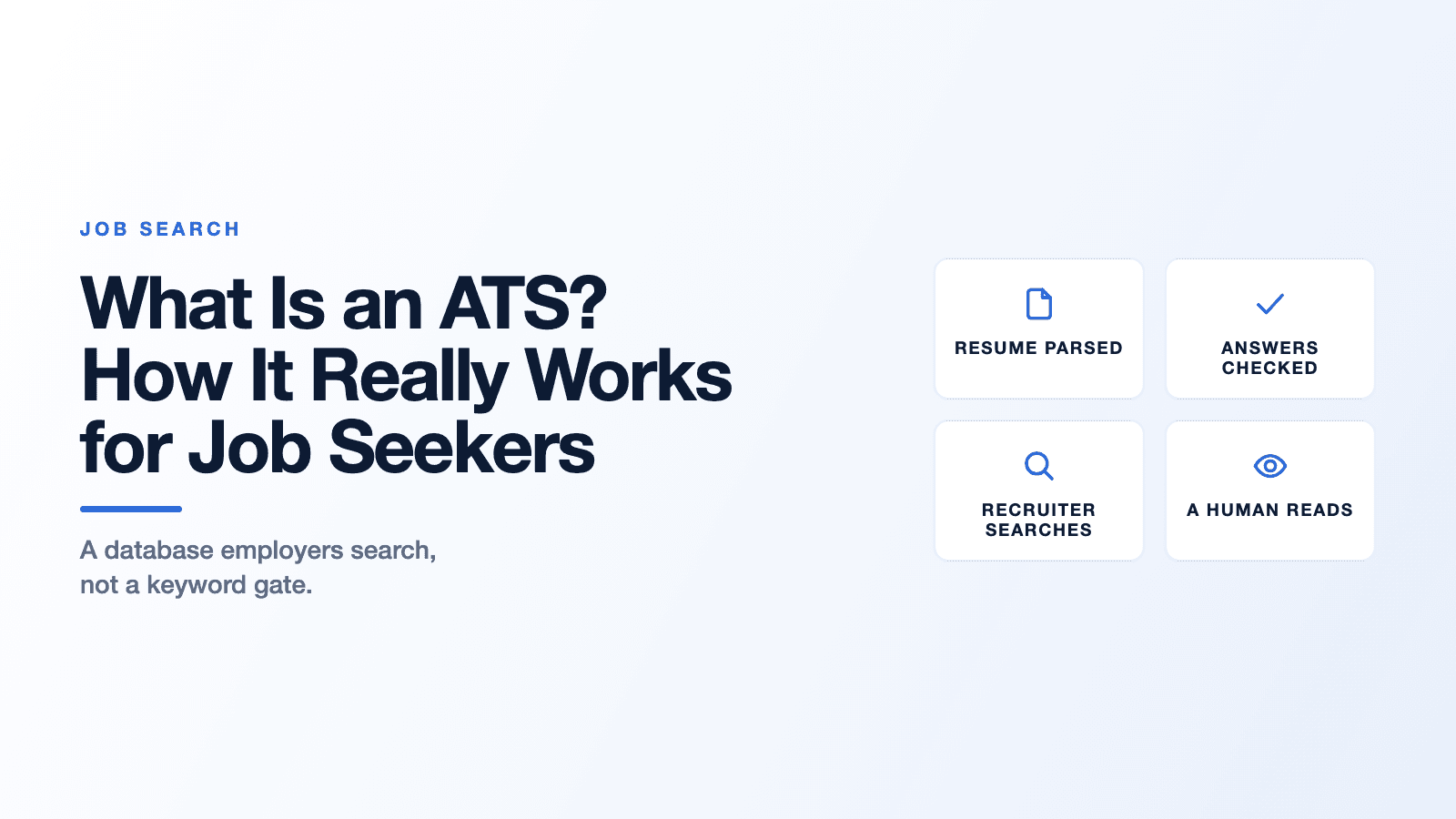
An ATS, or applicant tracking system, is the software an employer uses to collect, store, search and manage job applications. Most US employers use one. It can reject your application automatically, and the rejection that ATS vendors actually document is triggered by your answers to the application questions. None of the vendor documentation cited here describes a feature that bins your resume for missing keywords.
That distinction changes what you should do differently.
(Looking for a different ATS? In finance it means an alternative trading system, and in electrical work an automatic transfer switch. This post is about hiring software.)
What is an ATS, exactly?
Picture a filing cabinet with a search box bolted to the front. Every application a company receives lands inside it as a record: your resume, your answers to the application questions, your contact details, and every note a recruiter later writes about you. Common examples include Workday, Greenhouse, Lever, Ashby, Workable, iCIMS, Oracle Taleo and SmartRecruiters.
Employers use it because hiring at any scale falls apart in an email inbox. Harvard Business School and Accenture's 2021 report Hidden Workers: Untapped Talent found usage highest in the US, at 75% of the employers it surveyed. Keep that separate from a second finding in the same report: more than 90% of employers used their recruiting system to initially filter or rank candidates, 94% for middle-skills roles and 92% for high-skills ones.
Filter or rank. Not judge, not decide.
What happens to your application, step by step
In a typical setup, four things happen after you hit submit, roughly in this order.
A record gets created and your resume is parsed. Lever's documentation describes it plainly: the parser extracts information and populates the candidate profile with your name, work history and contact details. Parsing can fail, which is why Greenhouse publishes a support article on unsuccessful parses. A failed parse doesn't reject you. It leaves you with a half-empty profile that's harder to find in a search.
Your answers to the application questions get checked against the employer's rules. This is the automatic rejection the major vendors actually document. Greenhouse's help center says it directly: with auto-reject, a company can set rules so that "based on an applicant's answer to a question, they will automatically be rejected." Their own example is a trucking role where applicants without the required license are rejected on the spot. Ashby builds the same conditions from application answers, and Workable lets employers auto-disqualify anyone who answers "No" to a custom yes/no question. Recruiters call these knockout or disqualifying questions.
A recruiter searches the database. They type keywords, the way you'd search your own email. Greenhouse documents Boolean search with operators and modifiers for exactly this. If a recruiter searches for "Kubernetes" and your resume says "container orchestration", you're in the cabinet, but you're not in the results.
A human reads the shortlist. Employers can bolt extra steps onto this stage, like an assessment or their own scoring, but the shortlist that matters gets read by a person.
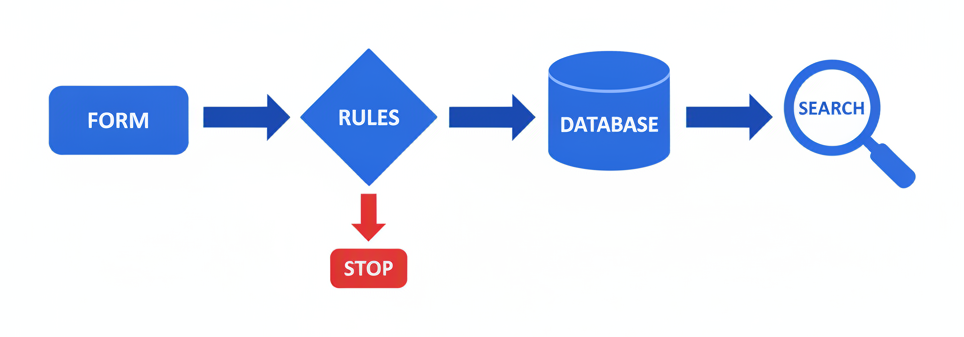
Stage 2 is the one that can end your application without a person involved. Stage 3 is the one that quietly decides whether a person ever sees you.
So does an ATS reject your resume?
Not for keywords, as far as any vendor documents. You've probably met the claim that software throws out most resumes before a human ever sees them. There is no published study behind that commonly repeated ATS-rejection claim. Treat it as folklore.
Here's the same question split into what people believe and what the vendors document:
| The claim | What the documentation shows |
|---|---|
| Software rejects your resume for missing keywords | None of the vendor documentation cited here describes such a feature. Keywords affect whether you appear in a recruiter's search |
| Automatic rejection isn't real | It is real, and Greenhouse, Ashby and Workable all document it. It fires on your answers to application questions |
| Any formatting flourish gets you binned | Bad formatting causes a bad parse, which leaves your profile thin. That's a visibility problem, not a rejection |
| The system scores you and cuts everyone below a threshold | Recruiting systems do filter and rank internally, but the percentage "ATS scores" job seekers quote generally come from third-party checkers rather than the employer's system |
The honest bad news sits somewhere else entirely. In that same Harvard and Accenture study, 88% of employers agreed that qualified high-skills candidates get vetted out because they don't match the exact criteria written into the job description. For middle-skills roles, 94% agreed. That's employers describing their own hiring, not a measurement of robot rejections. On their own account, the filter that costs you the interview starts as a narrow requirement a human wrote into the job description.
What to actually do about it
Answer the screening questions like they matter, because that's the part with a documented reject rule attached. Work authorization, location, notice period, salary expectations, licenses, years of experience. Read each one twice, and use the free-text box when your situation needs context. Open-ended questions like "why do you want to work here?" are a different job; here's how to answer "why do you want to work here" on an application form.
Use the employer's own words for skills you genuinely have. A recruiter searching the database will type the phrase in the job posting, not your preferred synonym, and some recruiting systems only return an exact match for the keyword. This is the real, unglamorous reason keyword advice exists, and it's the same discipline as tailoring your resume to the job description.
Keep the file boring. Most "ATS resume" advice reduces to this: one column, real text rather than an image, standard section headings, contact details in the body of the document. PDF and .docx are both standard uploads, so worry about the layout underneath rather than the extension. The systems document most of this themselves, including a file-size limit almost nobody mentions.
Don't stuff keywords or hide white text. A human reads your resume immediately after the search that surfaced it, and stuffing is obvious to them.
Write the cover letter for that same human. Nothing in these systems reads it for you, so the only question is whether the recruiter who opens it finds anything specific. That's a different job from matching keywords, and if you draft it with AI it's worth knowing what actually separates a letter that gets read.
Apply to fewer roles, more carefully. Given what employers say about exact-criteria filtering, twenty applications that clearly meet the stated requirements are worth more than two hundred that vaguely gesture at them. Twenty is also a number you can keep track of and follow up on, which two hundred is not. The US government's own jobseeker survey points the same way: measured offer rates peak well below the pace most advice recommends.
Where JobMason fits
Doing that for every job is slow, which is the problem JobMason was built for. Paste a job link and it turns a job posting into a tailored application pack: resume, cover letter, hiring-manager email and answers to the application questions, all editable before you export. Tracking your applications and all 12 resume templates are free with no card; AI generation is the part you pay for. It won't get you hired, but it makes the per-job version of this work fast enough to actually do.
Frequently asked questions
What does ATS stand for? Applicant tracking system. The same initials mean an alternative trading system in finance and an automatic transfer switch in electrical work, which is why search results for the term are a mixed bag.
Does an ATS automatically reject resumes? The automatic rejection these systems document works through rules the employer configures against your answers to the application questions. Greenhouse, Ashby and Workable each describe the feature in their help centers, and in every case the trigger is an answer you gave rather than a word your resume was missing.
Is a 70% ATS score good? That number most likely came from a third-party resume checker, which has no connection to the employer's system and no visibility into how that specific job was set up. Recruiting systems do rank candidates internally, and researchers at Harvard Business School and Accenture found that more than 90% of surveyed employers used theirs to filter or rank. You don't see that ranking, though, and no public benchmark defines a passing score.
Should I send a PDF or a Word document? Either is a standard upload. Since parsers work from the text in the file, a resume saved as an image gives them nothing to read at all, and heavily columned layouts risk being read in the wrong order.
Can I tell which ATS a company uses?
Often, from the address bar when you apply. job-boards.greenhouse.io is Greenhouse, jobs.lever.co is Lever, anything on myworkdayjobs.com is Workday, apply.workable.com is Workable, jobs.ashbyhq.com is Ashby. Larger employers sometimes map these to their own domain, in which case you can't tell from the URL.
The one-line version
So, what is an ATS? A database employers search. Answer the screening questions accurately, use the words the job posting uses, and keep your resume readable by both the parser and the person who reads it next.
Sources
- Harvard Business School / Accenture, 'Hidden Workers: Untapped Talent' (2021): usage was highest in the US at 75% of employers surveyed; more than 90% used their recruiting system to initially filter or rank candidates (94% middle-skills, 92% high-skills); and 88% of employers agreed qualified high-skills candidates are vetted out for not matching the exact criteria in the job description (94% for middle-skills).
- Greenhouse: auto-reject rules reject an applicant automatically based on their answer to an application question.
- Ashby: auto-reject conditions are built from a candidate's answers to application questions.
- Workable: employers can automatically disqualify candidates who answer 'No' to a custom yes/no application-form question.
- Lever: the resume parser extracts information and populates the candidate profile with name, work history and contact details.
- Greenhouse: resume parsing scans an imported resume and auto-fills fields, and can be unsuccessful.
- Greenhouse: recruiters search candidates using Boolean operators and modifiers.