How to Track Job Applications (and Know When to Follow Up)
A recruiter emails about a role you applied to five weeks ago. You can't remember which version of your resume you sent, whether you wrote a cover letter, or what the job paid. Twenty minutes go into digging through your sent folder before you can write two sentences back.
That's the problem people are trying to solve when they ask how to track job applications. Most advice answers with a column list. Columns are the easy part. The reason a tracker dies around week six is that it records what already happened and never tells you what to do on Tuesday morning.
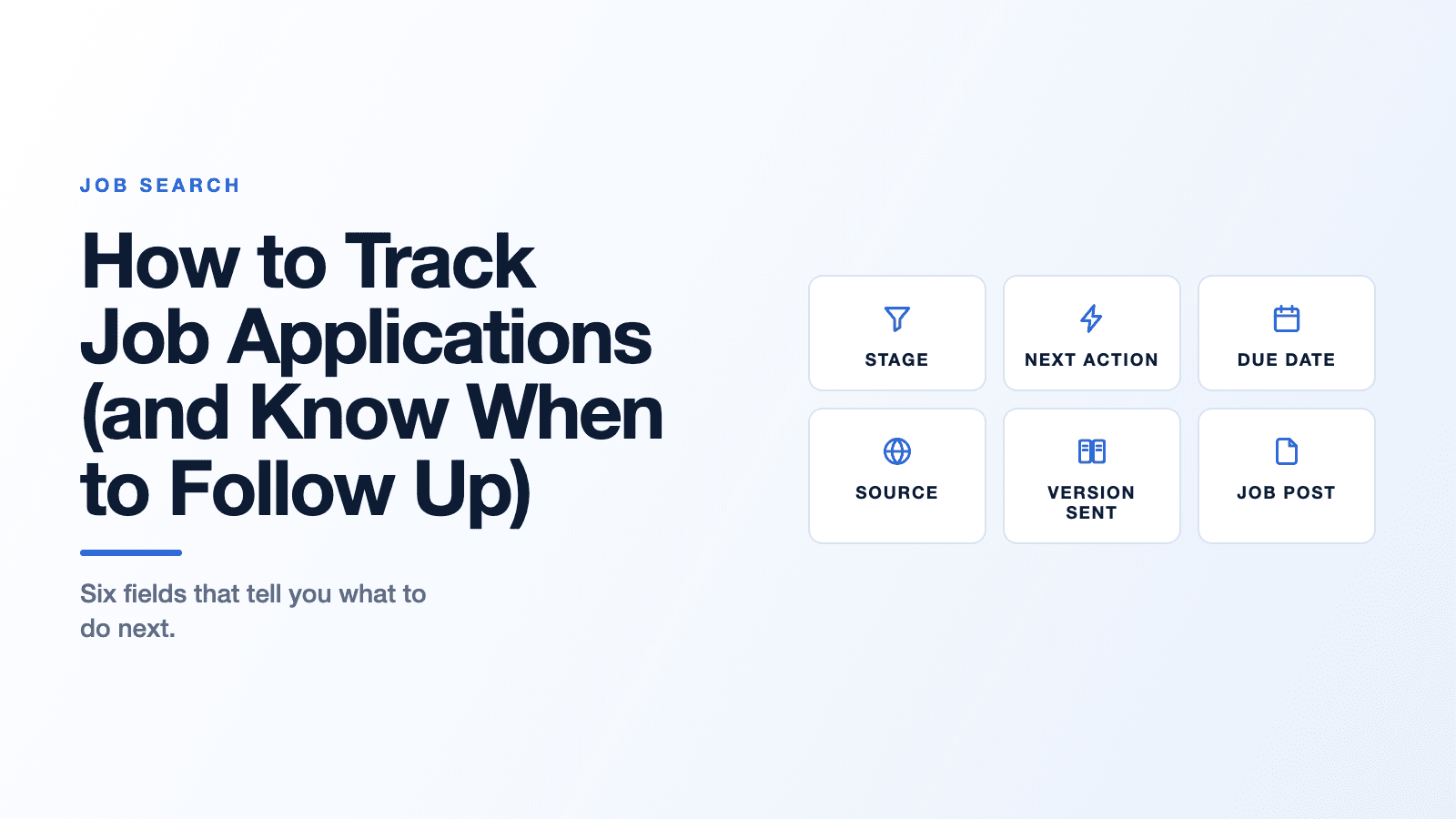
Short answer: track applications in whatever tool you'll actually open, a spreadsheet included. Six fields make it useful: stage, next action, due date, source, which version you sent, and a saved copy of the job post. Review it once a week for fifteen minutes. Nudge at day 7 to 10, and close a row after eight weeks of silence.
Why job searches lose the thread
Two numbers explain most of it.
The first is time. Average duration of unemployment in the US was 24.9 weeks in July 2026, and it has held between 23.7 and 26.0 weeks every month of 2026 (BLS, series LNS13008275). That's roughly six months among unemployed workers. Nobody's memory of a job posting survives that.
The second is volume. Ashby, an applicant tracking system, published figures from more than 109 million applications and 247,000 jobs on its platform between January 2021 and March 2026. In 2021, about 7% to 8% of applications resulted in an interview. Today the figure sits between 3.6% and 4.7% depending on the role. Ashby recorded more than 300 applications per hire on its platform throughout 2025.
Job seekers respond to those odds the only way available to them, by sending more applications. Applying more is a rational answer to a market like that. The pile of half-remembered applications is the side effect.
Volume isn't really what breaks a tracker, though. A spreadsheet full of company names and dates is a diary. Nothing in it ever says email Dana today.
The six fields that earn their place
You already know the obvious ones: company, role, date applied. Those are labels. Below are the fields that change what you do next, which is the only test a column has to pass.
| Field | What goes in it | The decision it forces |
|---|---|---|
| Stage | saved, applied, screening, interviewing, offer, closed | Which rows are live and which are archaeology |
| Next action | the next thing you do, written as a verb: "email Dana", "prep Thursday", "close" | Removes "waiting" as a status. Waiting isn't an action |
| Due date | when that action is due | Sorting by this column turns the tracker into a to-do list |
| Source | job board, referral, recruiter outreach, applied direct on the company site | Shows you which channels actually produce interviews |
| Version sent | the file name of the resume and cover letter that went out | Without it, nothing you learn later can be attributed to anything |
| Job post | the description pasted in as text, not just the link | Postings come down. You prep interviews against that text |
The source field pays off fastest. Gem's benchmark report, built from more than 140 million applicants and 1.3 million hires between January 2021 and December 2024, found that job boards and social sites produced 49.0% of applications but under 24.6% of hires, and that a sourced candidate, meaning someone a recruiter reached out to, was five times more likely to be hired than an inbound applicant. Your own split will look different from theirs. You'll only know what it is if you write it down.
The version field matters for a similar reason. If you're tailoring your resume to each job description, which you should be, you're running a small experiment every week without recording the conditions. Same for writing a cover letter with AI without sounding like AI: worth knowing which letters got replies.
Add contact, salary range and location if you'll use them. More postings now have to show a pay range by law, one of several job search tips for 2026 that change what you can ask for. Then cut any column you haven't looked at in two weeks.
Where to track job applications: spreadsheet, board, or app
No format wins on paper. The one that survives a bad week wins.
| Format | Works when | Where it breaks |
|---|---|---|
| Google Sheets or Excel template | You want filters, sorting and your own arithmetic. Free, portable, yours | Nothing nudges you. It only works with a calendar block attached |
| Kanban board (Notion, Trello, a tracker's board view) | You think in stages and like moving cards | Cards hide due dates. A board can look tidy while three rows quietly rot |
| Notes app | Fewer than about ten live applications | Falls apart the moment you need to sort or count |
| A dedicated job tracker | You want capture, stages and analytics without building them | You're inside someone's product, so check that you can export |
| The job board's own applied list (LinkedIn, Indeed) | A quick check of what you sent through that one site | Only holds applications made through it, so it can't be your system of record |
That last row is worth dwelling on. LinkedIn's own Job tracker has an Applied tab, and it will even show you the resume you used, as long as you applied for the job on LinkedIn. It knows nothing about the roles you sent through a company's careers page, and it has nowhere to put your next action. Use it as a source of truth for dates, then copy those dates into the tracker.
Switching tools is the most popular form of job search procrastination. Pick one this afternoon and put a repeating fifteen-minute block in your calendar. That block matters more than the tool.
When to follow up
Silence feels like a verdict. Usually it's a calendar.
Ashby puts time to first fill at 8 weeks for business roles and 10 weeks for technical ones. Gem measured average time to hire at 41 days, up from 33 in 2021, with 20 interviews per hire against 14 four years earlier. A role you applied to two weeks ago is often still collecting applications, and the person who'd reply to you is booked solid with interviews for the req they opened in June.
Here's the cadence worth defaulting to. It's a rule of thumb built on those timelines, not a research finding:
- Day 7 to 10. One short note to a named human, ideally the recruiter or hiring manager. Two sentences. Say which role, add one specific thing you'd bring to it, ask about timing. Here's what to write in a follow-up, with templates.
- Day 21. Second and last. Shorter than the first.
- After that, stop. Move on. The row stays open until the eight-week mark, but it stops costing you attention.
Following up feels pushy. It's also the part of this routine with the most evidence behind it. In a meta-analysis of 47 evaluated job search programmes, Liu, Huang and Wang found that the odds of obtaining employment were 2.67 times higher for participants than for controls, and that the effect was carried by particular components. Programmes that encouraged proactivity carried odds of 5.88 against control, versus 2.18 for programmes that didn't. That's evidence about structured programmes, not about spreadsheets. It does suggest a design principle for yours: the parts of a system that push you to act are worth more than the parts that archive.
When to close a row
Close it when any of these are true:
- Eight weeks of silence with no human contact
- The posting comes down and nothing happened
- You have something better live, and this one never got past a form
Change the stage to closed, write one line about why, and keep the row. Never delete. A closed row is what makes next month's numbers mean anything. Closed rows also reopen: when a recruiter reappears in October about a role you applied to in August, that row already holds the job description and the version you sent.
The fifteen-minute weekly review
Same time every week. Fifteen minutes, five moves:
- Sort by due date. Do every follow-up that's due or overdue.
- Close anything past eight weeks with no contact.
- Count last week: applications sent, replies, interviews booked.
- Write one target for next week at the top of the sheet: twelve applications, or three follow-ups, or one referral ask.
- Change one input based on what the count says. One, not five.
Step 4 isn't filler. In the same meta-analysis, programmes that promoted goal setting carried odds of 4.67 against control, versus 2.13 without it. Again, that's about programmes rather than trackers, and again the principle transfers: a target you wrote down does more work than a target you're carrying around in your head.
Your four numbers
Once the tracker has a couple of months in it, four rates fall out of it. Each one points at a different fix:
| Rate | How to compute it | What a weak number points at |
|---|---|---|
| Applied to reply | replies of any kind, including rejections, divided by applications sent | Your applications aren't being read. Targeting, or the resume itself |
| Reply to interview | interviews booked divided by replies | You get looked at and passed over. Match between your resume and the job's actual requirements |
| Interview to offer | offers divided by first interviews | Small sample, so watch the trend rather than the number. Interview prep, and the stories you tell |
| Applied to offer | offers divided by applications sent | The whole funnel in one number. Useful for deciding whether to change strategy or just do more of it |
Cut the same numbers by source while you're there. If every interview you've had came from a referral or a recruiter reaching out, that's your answer about where next week's hours go.
For context, and not as a target to hit: Ashby measured 3.6% to 4.7% of applications reaching an interview in its data, and offer conversion for candidates who get into the process at 10.4% for business roles and 7.3% for technical roles by early 2026. CareerPlug, looking at 2024 hiring across more than 60,000 small employers, averaged 180 applicants per hire, ranging from 57 in education and childcare to 234 in automotive.
That spread is the point. An average built from automotive and childcare hiring tells you nothing about your search in particular, which is the whole argument for measuring your own rates instead of borrowing someone else's. Once you have your own rates, they also settle the question of pace: how many jobs you should apply to works out to your target divided by the rate you actually convert at, and the US government's own jobseeker data has a lot to say about where that stops paying off.
The arithmetic is worth doing once. At a 4% application-to-interview rate, 25 applications works out to one interview on average. That's market-level arithmetic rather than a promise about your week, but it does mean twenty rejections is almost no information about you. Sixty applications with no reply at all is information.
What tracking job applications can't fix
Tracking is admin. It doesn't make you a better candidate, and a beautiful tracker full of rejections is still a pile of rejections.
If your numbers say applications go out and nothing comes back, the problem is upstream of the spreadsheet. It's usually targeting (you're applying to roles that don't match what your resume says you've done), or tailoring, or both. Fewer, better-matched, properly tailored applications beat volume, and it helps to know how an applicant tracking system handles what you send before you decide what to fix.
One practical note: your tracker holds recruiter names, salary conversations and your unfiltered opinions about companies. Keep it somewhere private, and assume any of it could be read over your shoulder in a coffee shop.
FAQ
What is the most effective way to track job applications?
One tool you'll open, six fields, one weekly review. The tool matters far less than the review. A plain Google Sheet with a next-action column and a repeating fifteen-minute calendar block beats an elaborate system nobody opens after week three.
How do I track my job applications?
Make a row for every application with company, role and date applied, then add stage, next action, due date, source, the resume version you sent, and the pasted job description. Sort by due date whenever you sit down with it, and review the whole thing once a week.
What is the hardest month to get a job?
December, on the available hiring data. In the US Bureau of Labor Statistics' Job Openings and Labor Turnover Survey, total hires (not seasonally adjusted) hit their lowest point of the year in December in each of the last three full years: 4.07 million in 2023, 3.87 million in 2024, and 3.88 million in 2025. November and February are the next lowest, and May and June are the busiest hiring months. That's total hiring volume rather than your personal odds. The practical read: keep applying through the quiet months, and expect replies to take longer over the holidays than your tracker's due dates suggest.
Is tracking job applications worth it?
Past about a dozen live applications, yes. Below that, your memory is fine and a notes app will do. It stops being worth it when the tracker becomes the work. Colour-coding it and migrating it to a new app are both ways of feeling productive without applying to anything.
Start with two columns
Tracking job applications pays off in one specific way: every Monday, the system hands you a short list of things to do instead of a vague feeling that you should be doing more.
Open whatever you're using now and add two columns: next action and due date. Fill them in for the live rows. Book fifteen minutes on Monday. That's the whole system, and it works in a spreadsheet you already have.
If you'd rather not build it yourself, JobMason includes application tracking as a Kanban board and a table, with analytics, multiple profiles, and all 12 resume templates, free forever and with no card required. The paid part is the AI generation, plus PDF export: a tailored resume, cover letter, hiring-manager email and application Q&A for one specific job, which is a different problem from the one this post is about.
Sources
- Ashby, Recruiter Productivity, 2026 Talent Trends Report (published 28 April 2026; over 109M applications and 247K jobs, January 2021 to March 2026): about 7-8% of applications resulted in an interview in 2021 against 3.6% to 4.7% today; candidates are roughly 50% less likely to receive an interview than five years ago; more than 300 applications per hire throughout 2025; offer conversion for candidates who reach the interview process at 10.4% for business roles and 7.3% for technical roles by Q1 2026; time to first fill of 8 weeks for business roles and 10 weeks for technical roles.
- Gem, 10 takeaways from the 2025 Recruiting Benchmarks Report (over 140 million applicants and 1.3 million hires, January 2021 to December 2024): job boards and social sites account for 49.0% of applications but under 24.6% of hires; a sourced applicant is 5x more likely to be hired than an inbound applicant; hiring teams conduct 42% more interviews per hire than in 2021 (20 against 14), contributing to a 24% increase in average time to hire (41 days against 33).
- CareerPlug, 2025 Recruiting Metrics Report (2024 hiring activity from more than 60,000 small business owners, over 10 million job applications): employers received an average of 180 applicants per hire in 2024, ranging from around 57 in education and childcare to 234 in automotive.
- US Bureau of Labor Statistics, Current Population Survey series LNS13008275, Average Weeks Unemployed (seasonally adjusted): 24.9 weeks in July 2026, and between 23.7 and 26.0 weeks in every month of 2026. Retrieved via the BLS public API and cross-checked against FRED series UEMPMEAN.
- US Bureau of Labor Statistics, Job Openings and Labor Turnover Survey series JTU000000000000000HIL, total nonfarm hires, not seasonally adjusted: December recorded the fewest hires of any month in 2023 (4,072,000), 2024 (3,873,000) and 2025 (3,879,000), with November and February next lowest and May and June the highest. Retrieved via the BLS public API and cross-checked against FRED series JTUHIL.
- Liu, S., Huang, J. L., and Wang, M. (2014), Effectiveness of Job Search Interventions: A Meta-Analytic Review, Psychological Bulletin, across 47 experimentally or quasi-experimentally evaluated interventions: the odds of obtaining employment were 2.67 times higher for participants than for controls; interventions that encouraged proactivity carried an odds ratio of 5.88 against 2.18 for those that did not; interventions that promoted goal setting carried 4.67 against 2.13.
- LinkedIn Help, View jobs you have applied for on LinkedIn: the Job tracker has an Applied tab, and you can review the resume you used for the job application if you applied for the job on LinkedIn.