How to Write a Cover Letter With AI (Without the Slop)
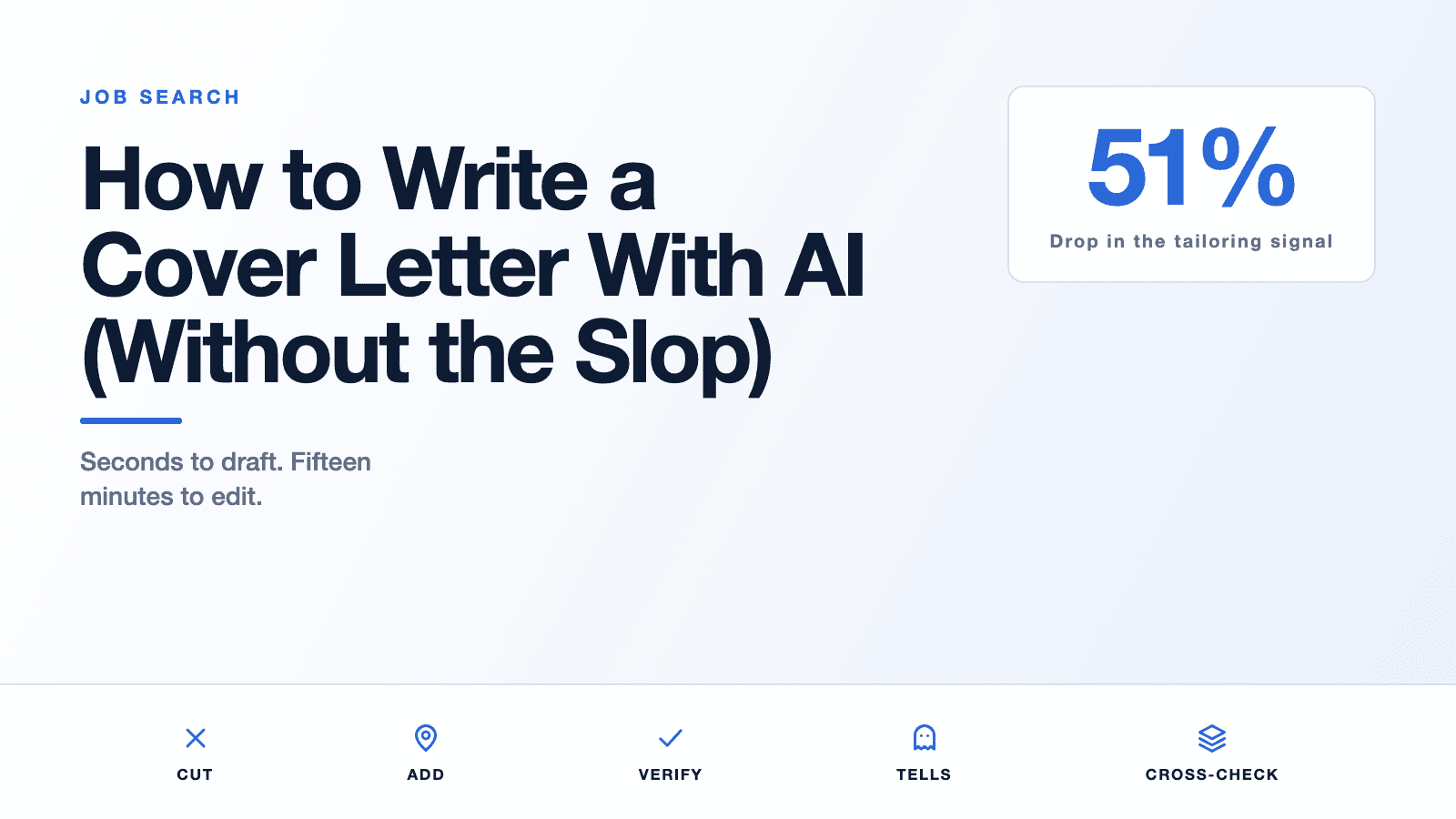
If you want to know how to write a cover letter with AI that a recruiter actually finishes reading, the answer isn't a better prompt. Use the model for the first draft, then spend your real time on the edit. A 2025 study of an AI cover-letter tool found the time applicants spent editing their drafts was positively correlated with hiring success. The draft takes seconds. The edit is the part with evidence behind it.
How to write a cover letter with AI: the short version
An AI-written cover letter is a first draft generated from your resume and a job posting. It becomes your cover letter only after you put back the specifics the model had no way to know.
The whole process:
- Give the model your real resume, the full job posting, and something true about why you want this job.
- Ask for a draft that flags its own gaps instead of inventing details.
- Delete every sentence another applicant could have signed.
- Add the numbers, projects, and reasons only you have.
- Check it against your resume, then send.
Most AI cover-letter advice stops after step 2. Steps 3 to 5 are where the letter gets good.
What changed: tailoring used to be the signal, now it's the floor
Nearly everyone has the same tool you do. LinkedIn's January 2026 research, run by Censuswide across 19,113 people and 6,554 HR professionals, found that 81% of people have used or plan to use AI in their job search. The same research reports US applicants per open role have doubled since spring 2022.
There is now research on what that did to the cover letter. In Signaling in the Age of AI: Evidence from Cover Letters, a 2025 preprint, Jingyi Cui, Gabriel Dias and Justin Ye studied one large online work platform before and after it introduced an AI cover-letter tool. Three findings, in the order they happened:
- Access to the tool increased how closely cover letters matched the job posts, and it raised callback rates. AI helped.
- Then the correlation between that matching and callbacks fell by 51%. Once every applicant could produce a well-matched letter, a well-matched letter stopped telling employers anything.
- Employers responded by leaning on other signals, including candidates' prior work histories.
Underneath those sits the useful one: time spent editing the AI-generated draft was positively correlated with hiring success.
So matching the job description is now the floor, not the edge. Keep doing it, the same way you still tailor your resume to the job description, just stop expecting the tailoring itself to impress anyone. Some people read this research and conclude the cover letter is dead; Knowledge at Wharton ran the headline "AI Is Killing the Cover Letter". But callbacks went up when people got the tool. What died is tailoring as a differentiator, not the letter.
Can employers tell if you use AI for a cover letter?
They think they can. In Insight Global's 2025 AI in Hiring Report, an Atomik Research survey of 1,005 US hiring managers at companies with 100 or more employees, 88% said they can tell when candidates use AI to help with applications, cover letters, or resumes, and 54% said they would care. That 88% is a self-report of confidence, not a measured detection rate. Nobody tested them.
Automated detectors do worse than that number implies. Stanford researchers tested seven widely used GPT detectors and found they were close to perfect on essays by US-born eighth-graders but classified 61.22% of TOEFL essays by non-native English students as AI-generated. Of those 91 essays, 89 were flagged by at least one detector. "Current detectors are clearly unreliable and easily gamed," said James Zou, senior author of the underlying study.
Detection and recognition are different problems, and the difference changes what you fix. Whether or not anyone runs your letter through a classifier, that is rarely what sinks it. What happens instead: a recruiter reads their two hundredth letter of the week, sees an opening line they have now seen two hundred times, and skims the rest. That isn't detecting AI. It's recognising generic, which is what Harvard's career services team warns about when it says generative AI "should not be the primary author" because its output "will likely be very generic."
So fix the genericness. Don't chase detectors, and don't overstate your experience to make a sentence land. A letter that wins an interview you can't back up costs you more than a boring one would.
How to use AI to write a cover letter draft worth editing
Bad inputs produce a letter about nobody. Give the model three things before you ask for anything:
- Your actual resume or profile, pasted in full, not summarised.
- The complete job posting, including the boring requirements section.
- Something real about the employer: what they build, a recent announcement, why the role interests you.
MIT's career advising team suggests treating the tool as "a brainstorming partner to help you craft the strongest cover letter in your own words", and one of their prompts is worth stealing outright: ask the model to review your resume and letter as if it were the hiring manager, then name what excites it and what gives it pause.
A prompt that produces an editable draft, not a finished one
Here is my resume, the job posting, and three things I know about the company.
Write a 250-word cover letter draft for this role.

Rules:
- Use only facts that appear in my resume. Invent nothing.
- Where a specific number, project name, or result would make a sentence
  stronger and you don't have one, write [TODO: need a number here] instead
  of writing around it.
- Plain sentences. No "I am writing to express my strong interest."
- End with a list of the three weakest claims in the draft and why.
That [TODO] instruction is the whole trick. Left alone, a model fills gaps with confident filler, and you end up editing prose that reads fine and says nothing. Forced to mark the gaps, it hands you a list of exactly the sentences that need you.
What not to paste in
Harvard's guidance includes a line people skip: "Don't share personal or proprietary data when using generative AI." That means your home address, and ID or licence numbers. Your own job history and skills are usually fine, though it depends on the tool's terms and settings. Anything your employer would consider confidential is not.
The edit that actually matters: five passes
Budget fifteen minutes. Each pass is one read-through with one job.
1. Cut every sentence another applicant could have signed
Read each sentence and ask whether a different candidate for the same role could put their name under it. If yes, it's filler. "I am excited to apply for this position, where I can contribute my strong communication skills and passion for innovation" is true of everyone who ever applied to anything. Delete it. Same for any sentence describing the company back to itself. They know where they work.
2. Put back what the model couldn't know
Four things it doesn't have access to:
- A number from your own work. Not an industry statistic, yours.
- A named project, tool, or decision you owned.
- The specific reason you're applying here, which usually comes from something you noticed about the company.
- Anything unusual in your history that a human would want explained, like a career change or a gap.
3. Verify every claim about you
MIT names the failure mode precisely: a model "might take certain aspects of the job description and ensure that the cover letter meets those needs, regardless of whether you have those qualifications," which can "oversell your qualifications and set you up for failure in the interview stages." Watch for years of experience you don't have, tools you've only read about, a seniority level a notch above your real one. Harvard's test is the one to use: be able to speak to every line if you're asked about it.
4. Strip the tells
MIT's list of what gives an AI letter away is short and accurate: em dashes used as punctuation, a formulaic structure, and writing so polished it stops sounding like a person. Their self-test beats any detector. Generate the letter twice. Whatever comes back the same both times is what the tool is handing everyone else who prompts it the way you did.
| What the model writes | What a person writes |
|---|---|
| "I am writing to express my strong interest in the Senior Analyst position." | "I've spent three years cleaning up reporting pipelines, and your job posting describes the exact mess I like fixing." |
| "My comprehensive skill set aligns seamlessly with your requirements." | "Two of your five requirements are things I did daily at my last job. Here's the third one, which I'm still learning." |
| "I am not only detail-oriented but also a strong collaborator." | "I catch things late in a project that other people miss, which makes me useful and occasionally annoying." |
| "I would welcome the opportunity to leverage my expertise to drive impact." | "I'd like to do this work at a company that ships weekly instead of quarterly." |
Two more habits to break: the "not only, but also" construction, and paragraphs where every sentence runs the same length. Vary the rhythm and the letter starts sounding like someone talking.
5. Read it against the rest of your application
This is the pass almost nobody does, and it's the one that catches real damage. Your cover letter, resume, follow-up email, and any application questions have to agree. A letter claiming five years of something your resume dates at three doesn't read as AI use. It reads as dishonesty, which is a worse problem to have.
Generating each piece in a separate chat is how the contradictions get in. So is generating them on different days. Read the four documents in one sitting, in the order a recruiter would, alongside what an applicant tracking system actually does with your application.
Then note which version went out with which application. A reply arrives five weeks later and you need to know what this employer actually read, which is the boring half of tracking a job search properly.
If you'd rather not assemble the pieces separately, that's what JobMason does: paste a job link and it drafts the resume, cover letter, hiring-manager email, and application Q&A together in one workspace, so the four start out consistent and you edit from there. AI generation is the paid part. Application tracking, all 12 resume templates, and multiple profiles are free.
Before and after: one paragraph, edited
An illustrative example. A data analyst is applying to a mid-size logistics company, and the model produces this:
I am a results-driven data analyst with a proven track record of leveraging data to drive business outcomes. My comprehensive experience with SQL and Python, combined with my passion for operational excellence, makes me an ideal candidate to contribute to your innovative team.
Nothing there is false. Nothing there is about anyone. Fifteen minutes of editing turns it into something like:
I spent last year rebuilding how my team reported on delivery exceptions. The old process took three days each month and produced a number nobody trusted; the version I built in SQL runs nightly and gets used in Monday planning. Your posting mentions route-level cost visibility, which is the same problem one layer down.
Same candidate, same length. The second version names a problem, a method, a result, and a line in the job posting. No model could have written it, because none of that was in the inputs.
When not to use AI for a cover letter
- The application explicitly asks you not to. Some do. Respect it.
- Writing is the job. For a copywriting, journalism, or comms role, the letter is the work sample.
- You can't answer "why do you want to work here" without the model inventing something. That's a signal about the application, not the tool. Start from how to answer "why do you want this job" instead.
- The letter only works if you overstate your experience.
FAQ
Is it okay to use AI to create a cover letter? Yes, on one condition: everything in the final letter has to be true and yours. MIT and Harvard both publish guidance on it, and both treat AI as a brainstorming and editing aid rather than a ghostwriter.
How do I get AI to write my cover letter?
Give it your full resume, the complete job posting, and real context about the employer, then ask for a draft that marks gaps with [TODO] instead of inventing details. Then edit: cut the generic sentences, add your own numbers and projects, and check every claim about your experience.
Can employers tell if you use AI for a cover letter? Not reliably, and the automated tools are worse than people assume. Stanford researchers found detectors flagged 61.22% of essays by non-native English writers as AI-generated. In Insight Global's survey 88% of hiring managers said they can tell, but that's what they believe, not a tested result. What they do notice is generic writing, which you can fix.
Can you use ChatGPT to write a cover letter? Any general-purpose assistant can produce a draft, and the process is the same whichever one you use. What you feed it matters far more than which one it is. Job-search tools differ mainly in that they pull the posting from a link and generate the matching resume and follow-up email alongside it.
How long should an AI-assisted cover letter be? There's no standard length, but around 250 to 350 words, roughly three short paragraphs, is a reasonable ceiling. Models default to longer and more formal than they should, so cutting length is usually the fastest way to make a draft sound human.
Should you still write a cover letter if it's optional? Write one when you have something specific your resume can't carry: a career change, a gap, a reason you want this particular employer. With none of those, an optional generic letter adds nothing.
The fifteen minutes that count
Knowing how to write a cover letter with AI is mostly knowing where to spend your attention. Generating the draft costs a few seconds and puts you exactly where every other applicant is standing. The editing is the part the research ties to getting hired, and it takes about fifteen minutes: cut, add what only you know, check it's all true, strip the tells, read it against your resume. Send it once at least one sentence in it could not have been written about anybody else.
Sources
- Cui, Dias and Ye, 'Signaling in the Age of AI: Evidence from Cover Letters' (arXiv preprint 2509.25054, 2025), studying an AI cover-letter tool on one large online labor platform: access to the tool increased textual alignment between cover letters and job posts and raised callback rates; time spent editing AI-generated drafts is positively correlated with hiring success; the correlation between textual alignment and callbacks fell by 51%; and employers shifted toward alternative signals, including workers' prior work histories.
- Knowledge at Wharton, 'AI Is Killing the Cover Letter'. This post counters that framing, since callback rates rose in the underlying research.
- Insight Global 2025 AI in Hiring Report (Atomik Research survey of 1,005 US hiring managers at organizations with 100+ employees, fielded 17-22 October 2024): 88% say they can tell when candidates use AI to help with applications, cover letters or resumes, and 54% say they would care.
- Stanford HAI (2023): GPT detectors were near-perfect on essays by US-born eighth-graders but classified 61.22% of TOEFL essays by non-native English students as AI-generated, and 89 of those 91 essays were flagged by at least one detector. James Zou: current detectors are clearly unreliable and easily gamed.
- Liang, Yuksekgonul, Mao, Wu and Zou, 'GPT detectors are biased against non-native English writers' (Stanford, published in Patterns, 2023): detectors consistently misclassify non-native English writing samples as AI-generated while native samples are accurately identified.
- MIT Career Advising and Professional Development: use AI as a brainstorming partner to write the letter in your own words; the recognisable tells are em dashes used as punctuation, a formulaic cover letter and over-polished writing that lacks a human touch; a model may meet the job description's needs regardless of whether you have those qualifications, which can oversell your qualifications and set you up for failure in the interview stages.
- Harvard FAS Mignone Center for Career Success: generative AI should not be the primary author because its output will likely be very generic; use generated text as a suggested edit, not as a final product; be able to speak to every line; and do not share personal or proprietary data when using generative AI.
- LinkedIn Research, January 2026 (Censuswide, November 2025: 19,113 consumers and 6,554 HR professionals): 81% of people have used or plan to use AI in their job search, and LinkedIn data shows US applicants per open role have doubled since spring 2022.