Why Do You Want This Job? How to Answer, With Examples
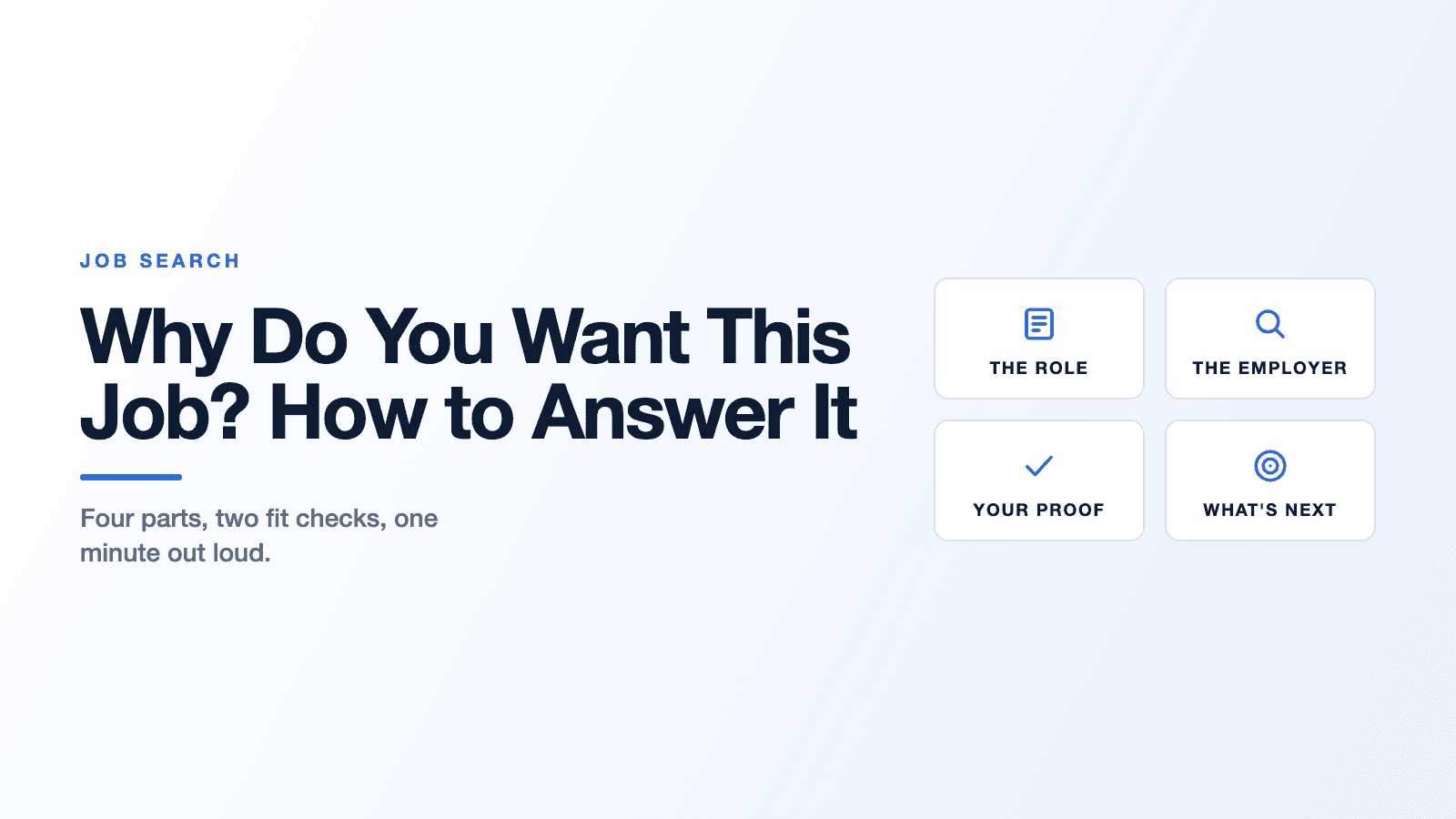
A strong why do you want this job answer covers two things at once: the role fits what you're good at, and the employer fits what you care about. Name one specific thing about the role, one specific thing about the company, one piece of proof from your own work, and what you want to do next. On an application form that can run a few hundred words. Out loud, keep it under two minutes, which means roughly half the written version.
"Why do you want this job?" is a fit check. The person asking is trying to predict whether you'll be good at this particular work and whether you'll still want it in a year. Enthusiasm helps only when it comes attached to evidence.
What "why do you want this job?" is really asking
It feels like a request to perform excitement. The research says it's two separate questions wearing one coat.
In a 2000 study published in Personnel Psychology, Amy Kristof-Brown found that recruiters form two distinct judgments about applicants. They lean on "knowledge, skills, and abilities" to judge person-job fit, and on "values and personality traits" to judge person-organization fit. In a field study with real recruiters, each judgment independently predicted hiring recommendations. Covering one doesn't cover the other.
Don't treat the values half as a formality. An earlier study by Daniel Cable and Timothy Judge followed 38 interviewers making hiring decisions about 93 applicants. The interviewers compared what they perceived an applicant valued with what their own organization valued, and those fit judgments had "large effects on their hiring recommendations relative to competing applicant characteristics." The recommendations then fed directly into job offers.
Employers also say this out loud. When Anthropic asked applicants to write their answer to "Why do you want to work at Anthropic?" without AI help in early 2025, the company told the Observer it wanted to assess "genuine interest and motivations" and was "looking for signals on what candidates value."
Why do employers care this much about motive? Because it hints at what happens after the offer. A 2005 meta-analysis of 172 studies linked person-job and person-organization fit to hiring outcomes like job offers, and also to what happens after people start: attitudes, performance, withdrawal and tenure. Your answer is one of their few early reads on whether you'll stick around.
One honest note before the structure. Penn Career Services opens its own take on this question with "It's really simple: 'Because you are hiring.'" That is often true, and nobody expects you to claim a lifelong dream. You're being asked for the reasons this job beats the other ones you could be doing. You almost certainly have some.
"Why do you want to work here?" vs "Why are you interested in this position?"
These are the same question with the weight on different halves, and you'll hear both, sometimes in the same interview loop. Use the wording to decide which half to lead with, then cover the other half anyway.
| How it's phrased | What it leans toward | Lead with |
|---|---|---|
| Why do you want to work here? / at this company? / for us? | The employer (person-organization fit) | What you know about them and why it matters to you |
| Why are you interested in this position? / this role? | The work itself (person-job fit) | The responsibility you want and the proof you can do it |
| Why do you want this job? | Both, evenly | Either, as long as both halves show up |
| Why are you leaving your current job? | Your reasons for moving | A different question. Answer it forward-looking and short |
How to answer "why do you want this job": a four-part structure
Four parts, usually one or two sentences each.
- The role. Pick one responsibility from the posting that you actually want to do, in the posting's own words. If you need help deciding which one matters most, pick out the requirements a posting repeats. Repetition usually marks what the hiring manager cares about.
- The employer. Name one specific, checkable thing about the company: a product decision, the customers they serve, how the team works, something they published. "Your mission" is the weakest version of this. "You moved your support team to regional shifts last year" is a strong one.
- Your proof. One example from your own work that connects to part 1. This is where the person-job half gets answered. Keep it to a result and what you did, not your whole history.
- What's next. What you want to learn or own in this job. Keep it about this role. "I want your job in three years" makes interviewers wonder how long you'll stay in this one.
That's it. The order can flex. For "why do you want to work here," open with part 2.
Talk about them more than you talk yourself up
There's an old finding that's useful here. In a 2004 field study, Chad Higgins and Timothy Judge surveyed 116 students interviewing through a university placement office about the tactics they used, then collected recruiters' ratings. Ingratiation, which in their definition covers things like agreeing with the interviewer's views and complimenting the interviewer or the organization, "had a positive effect on perceived fit and recruiter hiring recommendations." Self-promotion, talking up your own skills, had effects that were "generally weak and nonsignificant."
Read that narrowly. It's one study of student interviews, with self-reported tactics, from over twenty years ago, and nobody should take it as proof that flattery works. The narrower lesson: attention paid to the employer moved recruiters' sense of fit more than a list of strengths did. That's why the structure above opens with the role and the employer before it gets to you.
Specific beats flattering. Ben Lamarche, a recruiter at Lock Search Group, told College Recruiter that hiring managers want to "get a sense of who the candidate is" and not "just hear someone parroting what they think the interviewer wants to hear." Praising the company's values back to them is parroting. Noticing a real decision they made, and saying why it appeals to you, is something only a person paying attention can do.
Two swap tests before you use it
Run your draft through two checks.
- The company swap. Replace the company's name with a direct competitor's. If every sentence is still true, part 2 isn't specific enough. "A forward-thinking organization committed to innovation" survives this swap at every company on earth.
- The candidate swap. Imagine another applicant for the same role saying your answer. If they could say it word for word, part 3 needs a real example from your work.
An answer that passes both can only have come from you, about them. The same test works sentence by sentence on a cover letter, which is most of how to edit an AI cover letter draft until it sounds like you.
Written application vs interview: how the answer changes
The question now shows up before anyone has met you. Applicant tracking systems let employers add their own fields to the form; Greenhouse's documentation says custom application questions "allow your organization to collect information from candidates when they apply for a job," and employers can mark them required. A free-text "Why do you want to work here?" box isn't one of the yes-or-no knockout questions an applicant tracking system can auto-reject on. There's no correct option to pick, so write it for a human reader, and if it's marked required you can't skip it.
How long should the written version be? One data point from an employer: Anthropic's answers to "Why do you want to work at Anthropic?" typically ran 200 to 400 words and were valued "highly", according to the company. That's one employer, so treat the form's own limit as the real rule. When there's no limit, 150 to 300 words is my default: enough room for all four parts and a real example, short enough to read in a minute.
The spoken version has to be shorter. Indeed's career guide suggests you keep it to "less than two minutes". Linguists at the University of Pennsylvania found that recorded phone conversations between strangers averaged 152 to nearly 170 words a minute, depending on the topic. Rough arithmetic: a 300-word written answer read aloud takes about two minutes, right at that ceiling, and nobody reads aloud in an interview without sounding like they're reading. Cut the spoken version to about half.
| Written (application form) | Spoken (interview) | |
|---|---|---|
| Length | The form's limit; 150-300 words if none | About 1 minute, under 2 |
| Structure | All four parts, with a full example in part 3 | All four parts, example in one sentence; they'll ask for more |
| Who reads it, when | Whoever screens the application, before any conversation | The interviewer, live, with follow-up questions |
| What you can add | A link or detail they can check | Tone, and a follow-up question back to them |
| AI | Check the form's instructions; some employers set rules | Live, so it's just you |
Write the form answer in a document first, so you keep a copy if the page times out and you can run the swap tests before you paste it in.
Why do you want this job? Sample answers
These are illustrative examples written for this post, not real candidates. Borrow the shape, not the sentences. If you paste one in, it fails the candidate swap by definition.
Written, career changer (teacher moving into instructional design)
I want this role because it's the part of teaching I was best at, without the parts I wasn't. The posting says the designer will "turn subject-matter interviews into self-paced modules," and that's what I've spent the last two years doing for my school's new-teacher onboarding: I interviewed six department heads and rebuilt a two-day orientation into short online lessons that new staff finish before their first week.
I applied here specifically because your courses are built for frontline healthcare staff who learn on their phones between shifts. Designing for ten spare minutes on a small screen is a harder problem than designing for a classroom, and it's the one I want to get good at.
In this job I'd like to own a course from interview to launch and learn your authoring tools properly. I've used two of the three you list; I'd expect to need a few weeks on the third.
About 150 words. Role (part 1) and proof (part 3) arrive together in the first paragraph, the employer detail is specific enough to fail the company swap, and the last line is honest about a gap instead of hiding it.
Interview, early career (new graduate, data analyst at a regional grocery chain)
Mostly because the work is close to the shelf. The role is about store-level forecasting, and my capstone project was forecasting weekly demand for a campus food pantry, so I've already met the problem of a holiday week wrecking the model. I also read that you're expanding into two new states this year, and forecasting stores with no sales history is the part I'd most like to learn. I'd rather do that somewhere small enough that I'd see whether the forecast was right.
About 80 words, roughly 30 seconds aloud. It ends on what they want to learn, which is a fair thing for an entry-level candidate to want.
Interview, experienced (operations manager moving to customer success at a logistics software company)
I've been on the other side of your product. I ran a warehouse team that used a routing tool like yours, and the reason we renewed was the one person on the vendor's side who understood our dock schedule. This role is that person. I've handled the escalations your posting mentions from the customer chair, so I know which ones are urgent and which ones are really a training gap. And your public roadmap puts mid-size warehouses first, which is exactly the size I've worked in for eight years.
The proof here is the career change itself, which can be the strongest material a switcher has.
Hourly or frontline role
Honestly, the schedule works for me and I live ten minutes away, so I can be reliable about shifts. I also like that this location does click-and-collect, because I did online order picking at my last job and I'm fast at it.
Short is right here. Practical reasons are legitimate when they say something about reliability, and pairing them with one job-specific reason covers both halves of the fit question.
Before and after
A generic answer:
I've always admired your company and its commitment to excellence. This role is a great opportunity to grow my skills and take on a new challenge in a fast-growing industry.
The same candidate, after the four-part pass:
Your posting says the analyst will own the monthly churn report. I built the first version of ours at my current company, and I'd like to do it somewhere the data's already clean enough to get to the interesting questions. You've also published two posts on why customers leave in month three, which tells me the report gets read.
Every sentence in the first version passes the company swap and the candidate swap. Nothing in the second one does.
What not to say
- Pay or benefits as the whole answer. They're real reasons and nobody will be shocked you have them. They just answer neither fit question. Mention them as one factor at most, and save negotiation for later.
- "I'm looking for a new challenge." It describes what you want from any job. Run the company swap on it.
- The mission statement, read back to them. Quoting their values page tells them you found their values page. Pick a decision or a product that shows those values in practice and say why it appeals to you.
- Anything negative about your current employer. Even if it's deserved, it turns a question about them into a story about someone else.
- Claims you can't back up in the next question. If you say their onboarding approach drew you in, expect "what do you know about it?" next.
Can you use AI to answer "why do you want to work here"?
Read the application's own instructions first. Some employers set rules for exactly this question.
Anthropic is the clearest public case. Through early 2025 its applications put a note on the "Why do you want to work at Anthropic?" question asking applicants not to use AI assistants, so it could see their personal interest "without mediation through an A.I. system," per the Observer. By July 2025 it had replaced the ban with published guidance for candidates: for resumes and application questions, "Please create your first draft yourself," then use AI to refine. Its example of what's not allowed is asking an AI to write your application answers outright, with the result described as "Generic content with experiences you haven't actually had."
That's a useful rule even where no employer states it. An AI tool can't know why you want this job. It knows what you tell it. So tell it the specific thing that drew you in and the example you want to use. Then let it tighten the wording, and edit what comes back until it passes both swap tests.
If you're filling in a lot of these, JobMason has an application Q&A generator inside each job's workspace. You paste the question, add notes on what to highlight or leave out (this is where your real reason goes), and pick a tone and length. It drafts from your saved profile and the job posting, it's instructed not to invent experience or claim things your profile doesn't state, like work authorization or a start date, and the draft is yours to edit. AI generation is the paid part; tracking your applications and the resume templates are free.
FAQ
Why do you want this job sample answer example? An illustrative interview version: "The role is mostly store-level forecasting, which is what my capstone project was. I also read you're opening stores in two new states, and forecasting with no sales history is what I most want to learn." It names the role, a detail about the employer, your proof and what you want next. Use your own version of each.
Why do you want to join this company? Lead with the employer. Name one specific thing about how they work or what they've built, say why it matters to you, then connect it to one example from your own work. Avoid praise for their mission or values on its own, since any applicant could say it.
What are some good reasons to want a job? The work matches what you're good at, the employer does something specific you want to be part of, you'll learn a skill you want, or the practical terms (schedule, location, pay) let you do the job well. In an answer, lead with the first two and treat practical reasons as supporting ones.
How long should your answer to "why do you want this job" be? In an interview, about a minute and under two. On an application form, follow the stated limit; with no limit, 150 to 300 words covers it. A written answer read aloud runs long, so the spoken version should be roughly half.
Is it OK to say you need the money? It's true for almost everyone and it won't offend anyone, but on its own it doesn't tell the employer why this job rather than any other. Pair a practical reason with at least one reason that's about this role or this company.
Your next application
Before the next form or interview, write four lines: the role, the employer, your proof, what's next. Run both swap tests. That's your why do you want this job answer. The written version grows from it and the spoken version shrinks from it. If you're still deciding which roles deserve that much effort, start with these job search tips for 2026.
Sources
- Kristof-Brown (2000), Personnel Psychology: recruiters rely on knowledge, skills, and abilities to assess person-job fit and on values and personality traits to assess person-organization fit; in a field study with actual recruiters, both types of perceived fit offered unique prediction of hiring recommendations.
- Cable and Judge (1997), Journal of Applied Psychology: in data from 38 interviewers making hiring decisions about 93 applicants, interviewers compared applicants' values with their organizations' values, their person-organization fit assessments had large effects on hiring recommendations relative to competing applicant characteristics, and those recommendations directly affected hiring decisions such as job offers.
- Observer (February 2025): Anthropic said it wanted to assess people's genuine interest and motivations for working there and was looking for signals on what candidates value; responses to its Why do you want to work at Anthropic? application question typically ranged from 200 to 400 words and were valued highly; at the time its applications asked candidates not to use AI assistants so it could understand their personal interest without mediation through an AI system.
- Kristof-Brown, Zimmerman and Johnson (2005), Personnel Psychology: a meta-analysis of 172 studies and 836 effect sizes relating person-job and person-organization fit to pre-entry outcomes such as intent to hire and job offers and to post-entry outcomes including attitudes, performance, withdrawal behaviors and tenure; nearly all credibility intervals excluded zero.
- Penn Career Services (May 2026): the simple answer to why do you want to work here is because you are hiring, and the question is not a trick question.
- Higgins and Judge (2004), Journal of Applied Psychology: in a field study of 116 students using a university campus placement office, applicant ingratiation (such as opinion conformity and complimenting the other party) had a positive effect on recruiters' perceived fit and hiring recommendations, while the effects of self-promotion were generally weak and nonsignificant. Tactics were self-reported.
- Ben Lamarche, Managing Director at Lock Search Group, via College Recruiter (February 2026): hiring managers consistently say they want to get a sense of who the candidate is during the interview, not to hear someone parroting what they think the interviewer wants to hear.
- Greenhouse Support: custom application questions allow an organization to collect information from candidates when they apply for a job, and employers choose the answer type and whether the question is required.
- Indeed Career Guide: when answering why do you want this job, try to keep the answer to less than two minutes.
- Yuan, Liberman and Cieri (2006), Interspeech, University of Pennsylvania: in English telephone conversations between strangers, average speaking rate ranged from 152 to nearly 170 words per minute depending on the topic.
- Anthropic candidate AI guidance (last updated July 10, 2025): for resumes and application questions, candidates should create the first draft themselves and then use AI to refine it; asking AI to write application answers outright is not allowed and produces generic content with experiences the candidate hasn't actually had.