Job Search Tips for 2026: 10 With Evidence Behind Them
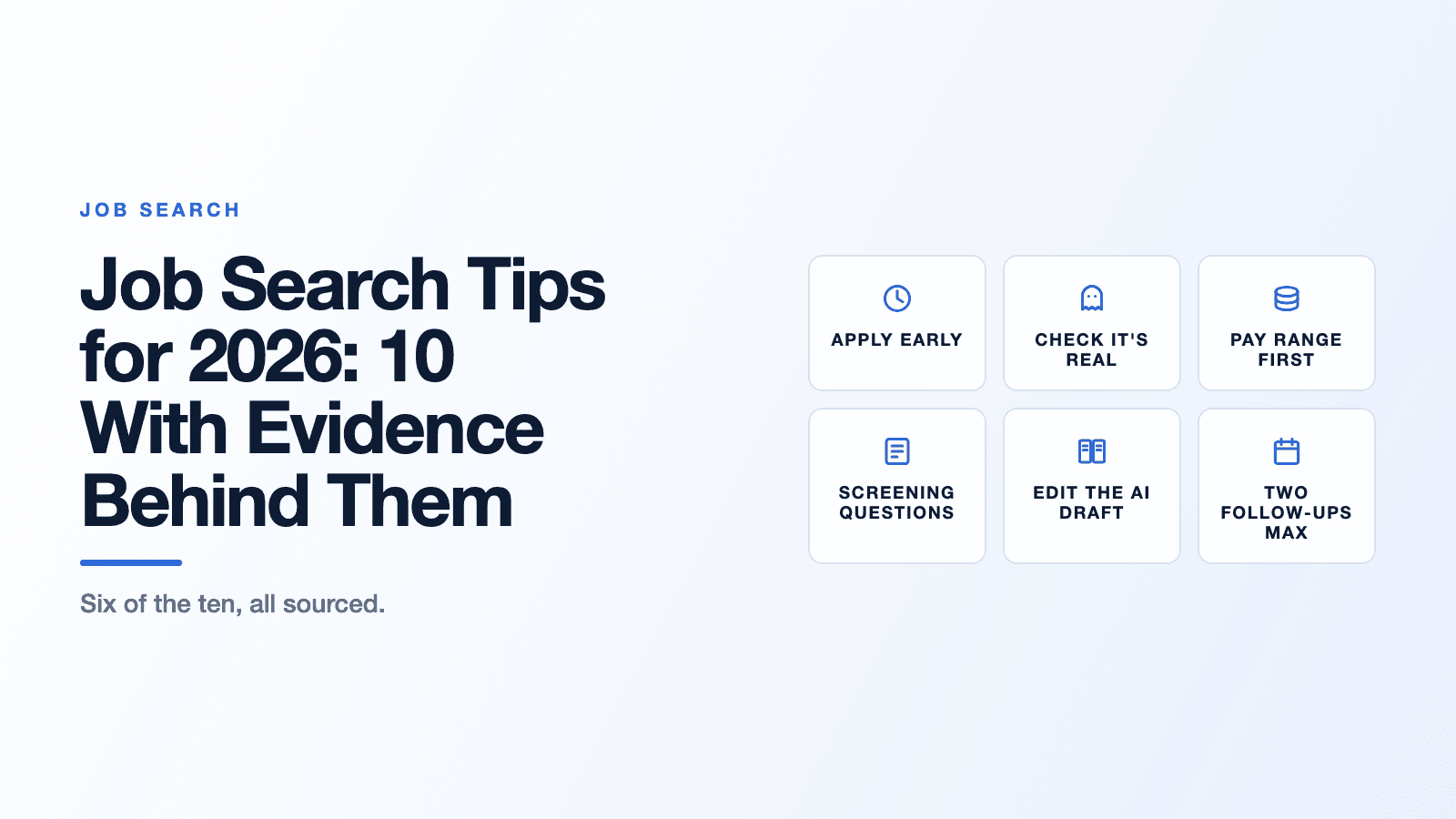
The job search tips that hold up in 2026 come down to fewer, better-aimed applications. Apply in the first few days a job is posted. Check that the job is real and read the pay range before you spend an hour on it. Tailor the top of your resume, answer the screening questions with care, let AI fix and draft but do the final edit yourself, and follow up no more than twice, on dates you set in advance. In some places the rules also changed this year in the applicant's favor, with pay ranges, AI-screening notices and, in Ontario, a 45-day deadline to hear back after an interview. Each tip below names the source it stands on.
A job search tip is worth following when it changes a rate you can measure, such as how many of your applications turn into interviews, or when it stops you spending time on jobs you were never going to get. Most lists skip that test. This one applies it.
A note on scope. This post is about applications: what you send, when, and what happens after. If you want LinkedIn's own features (its AI search, alerts, applicant counts), our sister site JobSieve covers them in its LinkedIn job search tips for 2026. And where an earlier JobMason post already covers a tip in depth, you'll get the short version and a link.
The 10 job search tips at a glance
| # | Tip | Why it holds up | Source |
|---|---|---|---|
| 1 | Apply in the first few days a job is posted | Postings on one large job board stayed up a median of seven days | NBER working paper, 125 million applications |
| 2 | Check the job is real before you invest an hour | 18 to 22 percent of Greenhouse postings per quarter are classed as ghost jobs | Greenhouse |
| 3 | Read the pay range first, and ask for it where you have the right | New pay-range rules in Ontario, Massachusetts and the EU | Government sources |
| 4 | Send fewer, closer-fit applications | Interviews per application have roughly halved since 2021 | Ashby, BLS |
| 5 | Tailor the top third of your resume to each role | A reader should see the match in seconds; our own estimate is about 20 minutes per role | JobMason guide |
| 6 | Treat screening questions as the real gate | Documented auto-rejects fire on answers, not resume keywords | ATS vendor docs |
| 7 | Send a file the software can read | Five vendors list PDF and Word as accepted; size and contact block can break a parse | ATS vendor docs |
| 8 | Let AI fix and draft, then do the edit yourself | Writing help raised hires 8%; editing time tracks hiring success | Management Science, arXiv |
| 9 | Put an inside route next to the application | Job boards bring 49.0% of applications but 24.6% of hires | Gem, Ashby |
| 10 | Follow up twice at most, on dates you set | 61% of job seekers say they've been ghosted after an interview | Greenhouse |
Why is it so hard to find a job right now in 2026?
Because each opening attracts far more applications than it used to, while hiring itself has slowed. The headline numbers don't look like a crisis, which is part of why the experience feels so confusing.
Start with the openings. The Bureau of Labor Statistics counted 7.3 million job openings in July 2026, against 6.9 million unemployed people that month. Divide one by the other and you get about 0.95 unemployed people per opening. On paper, there is roughly one job for every person looking.
Now look at how long people are looking. In August 2026 the average spell of unemployment was 26.3 weeks, up from 24.9 in July, and 1.9 million people had been out of work for 27 weeks or more, which is 27.0 percent of everyone unemployed (BLS, Employment Situation, August 2026). Hires were 5.1 million in July, a hires rate of 3.2 percent.
The missing piece is applications. Ashby, an applicant tracking system, analyzed more than 109 million applications for its 2026 Talent Trends Report. In 2021, about 7 to 8 percent of applications led to an interview. Now the figure is 3.6 to 4.7 percent, depending on role type. The average recruiter is processing 291 applications per hire, against roughly 100 in early 2021.
So the openings exist. What changed is the pile in front of each one. When a recruiter has three times as many applications to read, a generic one is worth less than it was in 2021, and a well-aimed one is worth more. Every tip below follows from that.
What changed for job seekers in 2026
Most job search advice reads the same every year. This year some of the rules actually moved, and a few of them give you something concrete to ask for.
| Where | What applicants get | Since | Who it covers |
|---|---|---|---|
| Ontario, Canada | Posting must state the pay or pay range, whether AI is used to screen, assess or select applicants, and whether the vacancy exists. Interviewed applicants must be told within 45 days whether a hiring decision has been made | January 1, 2026 | Employers with 25 or more employees; pay rule doesn't apply above $200,000 a year |
| European Union | A right to the starting pay or its range, for example in the job ad or before the interview. Employers may not ask about your pay history | Deadline for national laws: 7 June 2026 | Depends on your country's implementing law |
| Massachusetts | Pay ranges in job postings, and a right to the range when you apply | October 29, 2025 | Employers with 25 or more employees |
| New York City | Notice at least 10 business days before an automated employment decision tool is used on you, and a bias audit of that tool within the past year | Enforced since July 5, 2023 | Employers and employment agencies using such tools |
Sources: Ontario's Employment Standards Act guide, Directive (EU) 2023/970, Articles 5 and 34, Mass.gov on pay transparency, and NYC's Department of Consumer and Worker Protection.
Two caveats. An EU directive only binds employers once your own country has written it into national law, and countries moved at different speeds, so check yours. And this table is general information, not legal advice. If a specific employer's conduct matters to you, the government pages linked above are the place to start.
Job search tips for 2026: 10 job application tips that hold up
1. Apply in the first few days a job is posted
Job postings come down faster than most people assume. Economists Steven Davis and Brenda Samaniego de la Parra linked 125 million applications to the postings they went to on Dice.com, a job board for technical roles. Postings stayed up a median of seven days, often only two or three, and almost half of all applications went to openings posted in the previous 48 hours (NBER Working Paper 32320).
Scope matters here. That's one tech job board, with data from 2012 to 2017, and the paper measures when postings close, not whether early applicants get more interviews. But the practical point survives: a role you find on day nine may already be closed to new applicants, and the ones you find on day one are where most of the competition is heading anyway.
What to do: set alerts on the careers pages of the companies you want and on the one or two boards that actually carry your kind of role. Keep a base resume ready so that a tailored version takes twenty minutes, not an evening.
2. Check that the job is real before you spend an hour on it
Some postings aren't meant to be filled. Greenhouse, another applicant tracking system, reported that in any given quarter 18 to 22 percent of the jobs posted on its platform are classified as ghost jobs (Greenhouse 2024 State of Job Hunting report). In Ontario, covered employers now have to say in the posting whether the vacancy exists at all.
Then there are outright scams. Reported losses to job scams in the US more than tripled between 2020 and 2023, from $90 million to $286 million, and passed $220 million in the first half of 2024 alone (FTC Data Spotlight). The FTC's rules for spotting them are blunt. Honest employers "will never ask you to pay to get a job," and none will send you a check to deposit and then ask you to send part of the money back (FTC Consumer Advice). The FTC adds that task scams usually start with an unexpected text or WhatsApp message offering online work with no specifics.
What to do: before you tailor anything, find the same role on the company's own careers page. If it isn't there, or the posting has been up for months with no change, move it to the bottom of your list. In Ontario, read the vacancy statement too: if a covered employer says no vacancy currently exists, give that posting less of your time than one that says a vacancy does.
3. Read the pay range first, and ask for it where you have the right
A pay range is the fastest filter you have. If the top of the range is below what you need, no amount of tailoring fixes that, and you've saved an hour.
More postings now carry one by law. Ontario requires it for covered employers (under the $200,000 cap). Massachusetts has required ranges in postings since October 29, 2025, and gives applicants a right to know the range when they apply. In the EU, the Pay Transparency Directive gives applicants a right to the starting pay or its range before the interview and bars employers from asking what you earn now, though the deadline alone doesn't make those rights enforceable where you live until your country's own law is in force.
What to do: where you have the right, ask for the range in writing before the first interview. A simple line works: "Before we schedule, could you share the pay range for this role?" Where you don't have the right, asking is still normal, and the answer tells you something either way.
4. Send fewer, closer-fit applications
Volume is the one thing every applicant already has. Greenhouse found 38 percent of job seekers mass applying to roles, and Ashby's numbers show where that leads: interviews per application have roughly halved since 2021.
The volume advice you'll see everywhere, ten to fifteen applications a week, has no study behind it. We traced it in how many jobs to apply to, and what the data says. The one nationally representative US dataset that measured applications, interviews and offers together found offer rates were highest among people who sent 21 to 80 applications over two months. That's roughly three to nine a week, and it's a correlation, not a target.
What to do: if a role fails tips 2 or 3, drop it. Spend the time you save on the roles that pass.
5. Tailor the top third of your resume to each role
Tailoring is an edit, and a short one. You make one job's top requirements obvious in your headline, summary, skills and the first bullets under each role, using the posting's own wording where it's honestly true. A simple example: if the posting asks for a "customer success manager" and your current headline says "account manager", and you have done customer success work, put the posting's title at the top and move your strongest customer-retention bullet to first place. Our own estimate is about twenty minutes per role, not a measured figure. The full walkthrough is in how to tailor your resume to a job description.
6. Treat the screening questions as the real gate
Most people spend an hour on the resume and ninety seconds on the questions at the end of the form. That's backwards. The automatic rejection that applicant tracking vendors actually document, such as Greenhouse's auto-reject rules, is triggered by your answers to those questions (work authorization, location, years of experience, a required licence), not by missing resume keywords. We went through the vendor documentation in what an ATS actually rejects.
What to do: read every question before you start the form. A question like "Do you have at least five years of experience managing a team?" can be wired to an automatic reject rule, so if you have four and a half years plus a team you led on contract, the free-text box (if there is one) is where that context goes. Answer honestly, and where a question allows a sentence of context, use it.
7. Send a file the software can read
Greenhouse, Lever, Workable, Breezy and SmartRecruiters all list PDF and Word files among the resume formats they accept in their own documentation, so if you send either, file type is unlikely to be your problem. File size and where you put your contact details are more likely culprits. Greenhouse, for one, documents that it can't parse resumes over 2.5 MB, and lists contact details placed in a header, footer or text box among the causes of a failed parse. Greenhouse says those problems can leave a partial parse that someone has to correct by hand, so a resume with your name and email in the page header may reach the recruiter's system with those fields missing until a person fixes them. The rest of the vendor-by-vendor detail is in what makes a resume file ATS-friendly.
8. Let AI fix and draft, then do the edit yourself
The research on AI and applications splits into two findings, and they point the same way.
The first is about polish. In a field experiment with nearly half a million jobseekers on an online labor market, people who got algorithmic writing help on their resumes were hired 8 percent more often, at 10 percent higher wages, and employers were no less satisfied with them (Wiles, Munyikwa and Horton, Management Science). The tool was nongenerative. It fixed errors and made the writing easier to read; it didn't write anything new.
The second is about drafts. When a large online labor platform introduced an AI cover-letter tool, callback rates rose, but the link between how well a cover letter matched the job and whether it got a callback fell by 51 percent. And the time applicants spent editing the AI draft was positively correlated with hiring success (Cui and co-authors, arXiv preprint 2509.25054). That's a preprint from one platform, and the editing finding is a correlation. Still, it fits the obvious story: once everyone can produce a well-matched draft in seconds, the draft stops telling an employer much, and the specifics you add are what's left.
Our read: use AI as an editor and as a first-draft machine, and treat the unedited draft as a starting point every other applicant also has. The cover-letter version of this, with a prompt and an editing checklist, is in how to write a cover letter with AI.
9. Put an inside route next to the application, not instead of it
Career advice often says you should spend 60 to 70 percent of your time networking. We couldn't find a study behind that number.
The data that does exist is more balanced. Gem's 2025 benchmarks found job boards and social sites bring in 49.0 percent of applications but only 24.6 percent of hires (Gem), which means job-board applicants are hired at about half the rate their numbers would suggest. Gem points to employee referrals and direct sourcing as the higher-converting routes. But Ashby's 2026 report shows inbound applications grew from 38 percent of hires in 2021 to 52 percent by early 2026, with referrals and sourced hires at about 17 percent each. Among the employers in Ashby's data, most people hired in early 2026 came in through an application.
What to do: apply properly, and for the roles you care most about, also find one person at the company to message: a former colleague, an alumnus, the hiring manager if the posting names them. For a role you really want, two routes in are worth more of your time than another batch of untargeted applications.
10. Follow up twice at most, then close the row
Ghosting is common enough that you should plan for it. In Greenhouse's survey of 2,500 workers in the US, UK and Germany, 61 percent of job seekers said they'd been ghosted after a job interview.
So decide the dates before you need them. Our rule of thumb, which is a habit built on hiring timelines and not a research finding, is two follow-ups at most: a short note to a named person around day 7 to 10 after applying, a shorter second one around day 21, and then stop. After an interview, follow up if the timeline they gave you passes. In Ontario you now have a hard reference point: covered employers have to tell interviewed applicants within 45 days whether a decision has been made. Everywhere else, pick your own deadline and close the application when you reach it, so it stops taking up space in your head. The full cadence, including when to close a row, is in how to track job applications.
Where JobMason fits
Tips 5 through 8 are where the hours go. JobMason takes a job link and drafts a tailored resume, cover letter, hiring-manager email and answers to the application questions in one workspace, and you edit all of it before you export. The application tracker and all 12 resume templates are free; you only pay when you use the AI generators.
FAQ
Why is it so hard to find a job right now in 2026?
There are about as many job openings as unemployed people in the US (7.3 million openings against 6.9 million unemployed in July 2026), but each opening draws far more applications than it used to. Ashby's data shows applications per hire roughly tripled since early 2021, and the share of applications that lead to an interview fell from 7 to 8 percent to 3.6 to 4.7 percent. The average unemployment spell was 26.3 weeks in August 2026.
What is the best job search tool in 2026?
There isn't one best tool, because the jobs are spread across company careers pages, job boards and referrals. What helps most is a combination: job alerts so you apply early, a tracker you'll actually keep up to date, a resume file an applicant tracking system can parse, and a way to tailor each application quickly. Pick the simplest tool for each job and use it every week.
Is it better to apply to a job early?
Usually, yes. In a study of 125 million applications on the Dice.com job board, postings stayed up a median of seven days, often only two or three, and almost half of applications went to postings less than 48 hours old. A role you find late may already be closed to new applicants.
Should I use AI to write my job applications?
Use it, and edit what it gives you. A field experiment found that algorithmic writing help on resumes raised hiring by 8 percent, and a study of an AI cover-letter tool found that time spent editing AI drafts was positively correlated with hiring success. An unedited AI draft is what every other applicant can produce too.
The one thing to do this week
Pick the five roles you're most excited about. Run each through tips 2 and 3 first, and drop whatever fails. For the ones left, tailor the top of the resume, read every screening question twice, and put both follow-up dates in your tracker the day you apply. Fewer applications, each one checked and aimed, then followed up on a schedule: that's the core of every tip on this list.
Sources
- BLS JOLTS, July 2026 (released September 1, 2026): 7.3 million job openings; hires 5.1 million, a hires rate of 3.2 percent.
- BLS Employment Situation, August 2026 (released September 4, 2026): 6.9 million unemployed in July 2026 (seasonally adjusted); average duration of unemployment 26.3 weeks in August, up from 24.9 in July; 1.9 million long-term unemployed, 27.0 percent of all unemployed.
- Ashby 2026 Talent Trends Report (109M applications): interview rate per application fell from about 7 to 8 percent in 2021 to 3.6 to 4.7 percent; 291 applications per hire vs roughly 100 in early 2021; inbound applications grew from 38 to 52 percent of hires, referrals and sourced hires about 17 percent each.
- Ontario ESA guide: since January 1, 2026, covered postings must state pay or pay range, AI use in screening, and whether a vacancy exists; interviewed applicants must be told within 45 days whether a decision has been made; 25-employee threshold; pay rule not above $200,000.
- Directive (EU) 2023/970: applicants have a right to the initial pay or its range before the interview; employers may not ask about pay history; member states had until 7 June 2026 to transpose.
- Massachusetts: since October 29, 2025, employers with 25 or more employees must disclose pay ranges in postings and to applicants.
- NYC Local Law 144: bias audit within one year and notice to candidates 10 business days before an automated employment decision tool is used; enforced since July 5, 2023.
- Davis and Samaniego de la Parra, Application Flows, NBER WP 32320: on Dice.com postings last a median of seven days, often two or three; almost half of applications go to postings under 48 hours old.
- Greenhouse 2024 State of Job Hunting (2,500 workers, US, UK, Germany): 61 percent ghosted after an interview; 18 to 22 percent of Greenhouse postings per quarter classified as ghost jobs; 38 percent of job seekers mass applying.
- FTC Data Spotlight (December 2024): reported job-scam losses rose from $90 million (2020) to $286 million (2023) and topped $220 million in the first half of 2024.
- FTC: honest employers will never ask you to pay to get a job, and none will send a check to deposit and ask you to send part back.
- Greenhouse auto-reject rules reject applicants based on their answers to application questions.
- Greenhouse cannot parse resumes larger than 2.5MB; contact details in a header, footer or text box are a listed cause of a failed parse.
- Wiles, Munyikwa and Horton, Management Science (2025): nongenerative writing assistance on resumes raised hiring 8 percent and wages 10 percent, with employers no less satisfied.
- Cui et al., arXiv 2509.25054: an AI cover-letter tool raised callbacks; editing time on AI drafts correlated with hiring success; the alignment-callback correlation fell 51 percent.
- Gem 2025 benchmarks: job boards and social sites are 49.0 percent of applications and 24.6 percent of hires.