How to Follow Up on a Job Application (and When to Stop)
It's day nine. You applied for a role you actually want, the confirmation email arrived within a minute, and since then: nothing. You've drafted a follow-up three times and deleted it three times, because you can't decide whether it makes you look keen or desperate.
Here's how to follow up on a job application without guessing.
Short answer: send one short email to a named person, usually the recruiter or hiring manager, 7 to 10 days after you apply. Keep it under 125 words, with a subject line of a few words, one specific reason you fit the role, and one question about timing. If nothing comes back, send one more note about two weeks later. Then stop, and put that energy into your next application. Silence is the normal outcome, and it isn't a verdict.
A job application follow-up is a short message to a specific person at the company, sent after a set interval, that confirms you're still interested and asks one clear question. That's the whole job. It doesn't resend your application or re-argue your resume.
Should you follow up on a job application at all?
Yes. Hardly anyone who hires says otherwise.
In 2017 the staffing firm Accountemps asked more than 300 US HR managers how long a job seeker should wait before following up on a resume. Every answer was some length of time. The option "they shouldn't follow up" got 0%. Six years earlier, the same firm put a similar question to more than 1,000 senior managers, and just 1% said applicants shouldn't check in.
Be clear about what that evidence is, though. Those surveys record what managers say they prefer. They don't measure whether a follow-up gets anyone more interviews, and while researching this post we couldn't find a study that does. So treat following up as a cheap, low-risk move with a plausible upside (a person opens your file again) rather than a proven lever.
It's also a move most people skip. When Robert Half asked Australian workers in 2024 what they'd do if they felt an employer was ghosting them, 35% said they'd do nothing at all, and only 26% said they'd ask the hiring manager for an update. That's one country and a hypothetical question. Still, it suggests a polite, specific note puts you in a minority.
How long to wait to follow up on a job application
Every guide tells you to wait a week or two. Almost none says why. There are two good reasons, and they agree.
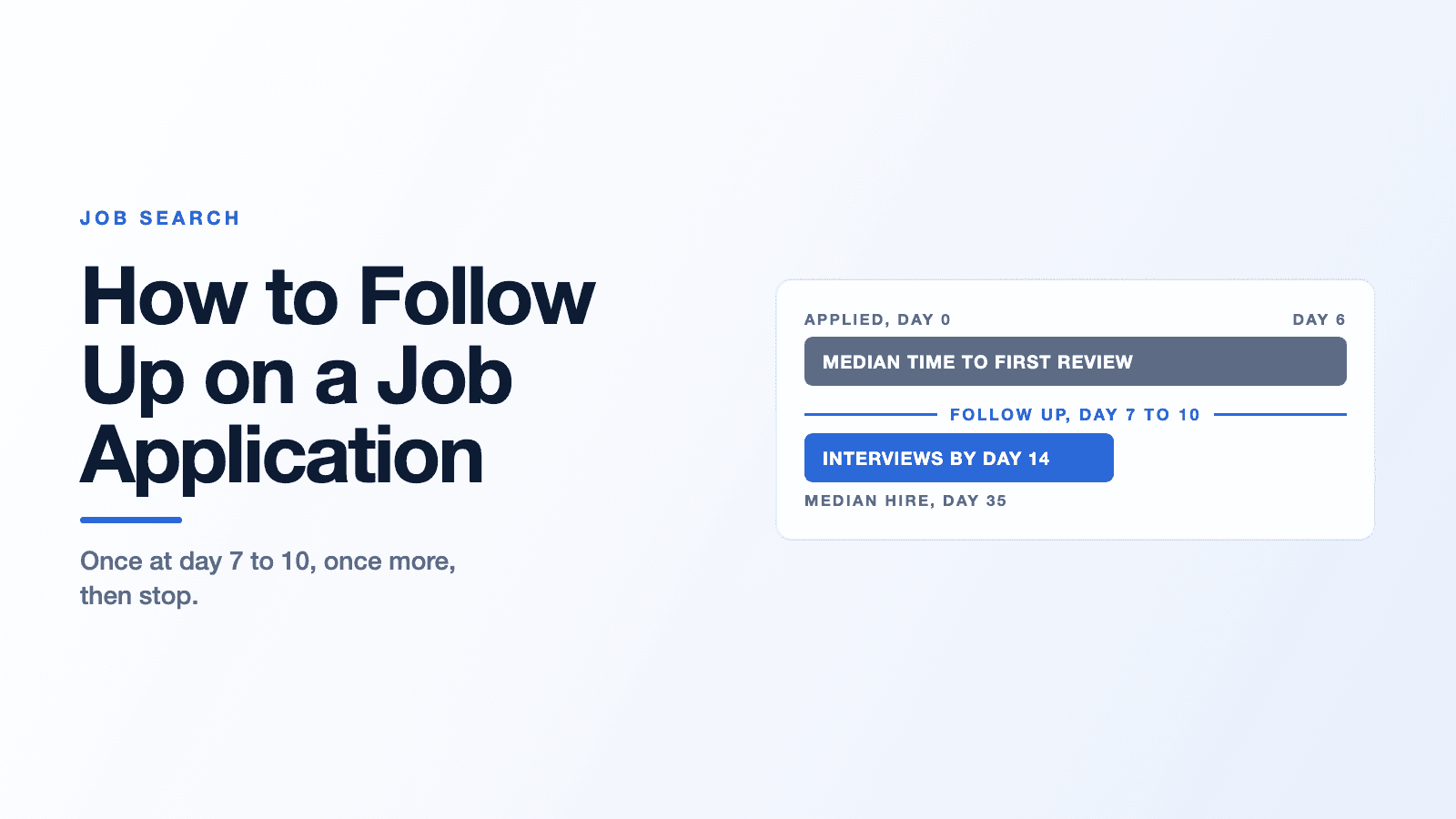
The first is how fast a hiring pipeline actually moves. SmartRecruiters, an applicant tracking system, published benchmarks from 89 million applications for 1.5 million jobs processed between September 2023 and August 2024. For US jobs, the median was 6 days to review an application, 14 days to interview, and 35 days to hire.
Lay your follow-up on top of that timeline and the window explains itself:
| Day | What's probably happening on the other side | What you do |
|---|---|---|
| 0 | Your application lands in a pile with dozens of others | Nothing. Note the date |
| 1 to 6 | First review pass. The US median is done by day 6 | Wait. A note now arrives before anyone has looked |
| 7 to 10 | Probably a shortlist taking shape, before most interviews are booked | Send your first follow-up |
| by 14 | Median first interviews | If you've heard nothing, keep waiting a few more days |
| about 21 | Interviews under way, or the role went quiet | Send the second and last note |
| 35 | Median hire | Treat continued silence as closed |
These are medians across one vendor's customers, not a promise about any single employer, but the shape is what matters. A note at day 7 to 10 is likely to reach someone who has recently sorted the pile and hasn't booked every interview yet. A note at day 3 is likely to reach someone who hasn't opened it.
The second reason is what managers say. In that 2017 Accountemps survey, 29% said follow up within a week, 36% said one to two weeks, 25% said two to three weeks, and 10% said three weeks or more. Add the first two and that's 65% inside the two-week mark. Accountemps' Bill Driscoll told CNBC that checking in just a few days after applying can make you look pushy.
A few cases move the clock:
- The posting lists a closing date. Count from the close, not from the day you hit submit. A team that set a deadline may not open the pile until it passes.
- The posting says no calls or no contact. Respect it. Breaking an explicit instruction is the one follow-up that can actually cost you.
- A recruiter or agency submitted you. Follow up with the recruiter, not the company. They own the relationship, and going around them rarely helps.
- Someone referred you. Tell the referrer you applied, and ask whether they'd mention it or point you to the right person. Then follow up with that person by name, mentioning the referral in the first line.
Email, phone or LinkedIn: where to send it
Email, in most cases. When Accountemps asked those HR managers for the best way to follow up after submitting a resume, the answers split like this:
| Channel | Share of HR managers who called it the best way (2017) |
|---|---|
| 64% | |
| Phone call | 21% |
| In person | 14% |
| Social media | 1% |
| Text message | 0% |
Email wins because the reader picks the moment. A phone call interrupts, and a voicemail asks someone to transcribe you. Our view: call only when the job itself lives on the phone (sales, some trades, front-desk roles), or when the posting gives a number and invites calls.
Who gets it matters more than the channel. In our view a named hiring manager or recruiter is a far better target than a generic careers@ inbox, which may be shared, filtered or rarely read. Places to find one:
- The posting itself, which sometimes names the recruiter.
- LinkedIn's Meet the Hiring Team section on a job's page. LinkedIn says members can connect with and message the entire team listed there, including the job poster.
- The job poster's profile, if they chose to show it. LinkedIn notes the poster's profile appears only if the poster opts in, and that an applicant who isn't connected can still send an InMail or ask a mutual connection for an introduction.
- The company's own site. Team pages, press releases and engineering or design blogs often name the person who runs the team you applied to.
If you find a work email, use it. If you only find a LinkedIn profile, a short message there is fine. Don't send the same note through three channels at once. That's the version that reads as pressure.
What to say when following up on a job application
There's no large study of follow-up emails specifically. There is a large study of emails that get answered. Boomerang, an email plugin, analysed over 40 million messages its users wanted replies to, and found:
- Emails of 50 to 125 words had response rates above 50%, sliding to about 44% at 500 words.
- Subject lines of 3 to 4 words got the most responses. Emails with no subject line at all got 14%.
- Emails asking one to three questions were 50% more likely to get a reply than emails asking none.
That's ordinary email, not job applications, so read it as a sensible default rather than a hiring finding. It happens to match what a busy recruiter needs from you anyway.
Here's the shape we'd use:
- Subject: the role name and the word application. "Data analyst application" is enough.
- Line one: which role, and when you applied.
- Line two: one specific reason you fit, tied to something in the posting. One. If you need help finding it, the same thinking goes into answering why you want this job.
- Line three: one question you'd genuinely like answered, usually about timing.
- Sign-off with your phone number, so replying by phone takes one tap.
Leave out:
- Salary. Accountemps lists it under the don'ts: a follow-up on your application "is not the time to bring up compensation, benefits and perks."
- Your whole application, re-attached. They have it. Attach a resume only if you've genuinely updated it.
- Apologies and guilt. "Sorry to bother you" and "I know you're busy" add words and subtract confidence.
- "Just checking in" with nothing else in the email. Give them something to respond to.
Job application follow-up email templates
These are our own wording, written to the rules above. Nobody has A/B tested them, us included. Change the details until they sound like you, because a template that reads like a template defeats the purpose.
First follow-up email (day 7 to 10)
Subject: Data analyst application
Hi Priya,
I applied for the Data Analyst role on 8 September and wanted to confirm it reached you.
The posting mentions rebuilding the weekly churn report. I did something close to that at Northwind, where I moved a manual Excel report into a scheduled dashboard and cut the prep time from a day to an hour.
Is there a rough timeline for first interviews?
Thanks, Sam Lee 555-0142
Priya, Sam, Northwind and the numbers are invented for the example. Swap in your own real detail. The email is about 70 words, inside Boomerang's range.
Second and last follow-up (about day 21)
Subject: Re: Data analyst application
Hi Priya,
Following up once more on the Data Analyst role. I'm still very interested, and happy to send a work sample if that would help.
If the role's been filled or put on hold, a one-line reply would be great so I can plan.
Thanks, Sam
Reply in the same thread so the first email sits right underneath. Shorter than the first, and it gives them an easy way to close the loop.
LinkedIn message to the hiring team
Hi Priya, I applied for the Data Analyst role on 8 September. I've rebuilt a churn report much like the one in the posting and would love to talk about it. Is there a timeline for interviews?
Three sentences, so it works as a connection note or a direct message. If you're already connected, send it as a message.
When you have another offer
Subject: Data analyst application timing
Hi Priya,
I applied for the Data Analyst role on 8 September. I've since received an offer elsewhere with a decision due on the 26th, but your team is my first choice.
Is there any chance of an update before then?
Thanks, Sam
Only send this if the offer is real. It's the one follow-up that can legitimately speed things up, and it falls apart if they ask a question you can't answer.
Voicemail, if you must call
Hi, this is Sam Lee. I applied for the Data Analyst role on 8 September and wanted to check on the timeline. I'm on 555-0142. I'll also send a short email so you have my details. Thanks.
Under 20 seconds. Then send the email you promised.
What silence means, and when to stop
Silence feels personal. Mostly it's the system.
In the second quarter of 2024, only 4% of roughly 6,500 companies using Greenhouse, another applicant tracking system, contacted every rejected applicant, according to Greenhouse's own data reported by Axios. Thirteen percent of those employers ghosted more than half of their applicants. Greenhouse's president gave reasons that have nothing to do with you: a recruiter fills the job and closes it without switching on rejection emails, or keeps runners-up warm until the top candidate moves forward.
It doesn't stop at the application stage either. In Greenhouse's 2024 survey of 2,500 workers in the US, UK and Germany, 61% of job seekers said they'd been ghosted after a job interview.
So no reply is the default, not a signal. That cuts both ways. It means one unanswered note says nothing bad about you. It also means you shouldn't wait on any single application.
The stop rule we'd use: two messages, then done. Driscoll's advice to CNBC readers was the same: one more follow-up after an unanswered email, and that's the max. Accountemps' own list of don'ts ends on the same note: if you never hear back, "it's time to move on." With a median hire at day 35 in that SmartRecruiters data, a role that's still silent past five weeks may well have moved on, and it's no longer worth your waiting time.
Moving on doesn't mean deleting the row. Log both follow-up dates and close the application after a set period. If you want a system for that, here's how to track job applications so the tracker tells you when a follow-up is due. It uses the same day 7 to 10 and day 21 rhythm as this post.
And if you're following up on dozens of silent applications every week, the follow-ups aren't the problem. The applications are. Fewer, better-aimed ones get more replies, which is the case we made in how many jobs to apply to.
FAQ
How long should you wait to follow up on a job application?
About 7 to 10 days. US hiring teams on SmartRecruiters had a median of 6 days to review an application and 14 days to interview, so a note in that gap arrives after the first review and before interviews fill up. In a 2017 Accountemps survey, 65% of HR managers said to follow up within two weeks. If the posting lists a closing date, count from the close.
Is it OK to follow up on a job application?
Yes. In Accountemps' 2017 survey of more than 300 HR managers, none said candidates shouldn't follow up, and in its 2011 survey of more than 1,000 senior managers only 1% did. Keep it short and polite, and respect any posting that says no contact.
Should I call or email to follow up on a job application?
Email, unless the posting invites calls or the job is phone-based. In the 2017 Accountemps survey, 64% of HR managers named email as the best way to follow up, against 21% for a phone call.
How do you follow up on a job application without being annoying?
Send two messages at most, about two weeks apart, each under about 125 words, to one person through one channel. Make each one specific to the role and end with a single question. Skip the follow-up entirely if the posting says no contact, and never call repeatedly or bring up salary.
How many times should you follow up on a job application?
Twice at most. Send the first note around day 7 to 10 and a shorter second one about two weeks later in the same thread. If neither gets a reply, move on and spend the time on new applications.
The next ten minutes
Open your sent applications and find every one that's between 7 and 10 days old. Write one follow-up for the one you want most, using the first template, and send it to a named person. That's the whole method for how to follow up on a job application: right day, right person, one specific line, one question, then let it go.
If the hard part is the specific line, JobMason has an email generator that drafts an outreach email to the hiring manager from your profile and the job posting, with a tone setting, and you edit it before you copy it out and send it yourself. It's written for first contact, so for a follow-up, keep its strongest sentence and cut the rest down to the shape above. The generator is one of the paid AI features; tracking your applications and follow-up dates is free. More on keeping a search moving in our job search tips for 2026.
Sources
- Accountemps survey of more than 300 HR managers at US companies with 20+ employees (Sept 2017): asked how long a job seeker should wait to follow up after submitting a resume, 29% said less than one week, 36% one to less than two weeks, 25% two to less than three weeks, 10% three weeks or more, and 0% said they should not follow up. Best way to follow up: email 64%, phone call 21%, in person 14%, social media 1%, text message 0%. Advises not to discuss salary in a follow-up and to move on if you never hear back.
- Accountemps survey, telephone interviews with more than 1,000 senior managers at companies with 20+ employees (Oct 2011): 81% encouraged candidates to follow up within two weeks of applying (one week or less 38%, one to two weeks 43%); only 1% said applicants should not check in.
- CNBC Make It (Oct 2017), reporting the Accountemps survey: Accountemps district president Bill Driscoll said that if you followed up by email and don't hear back it is OK to follow up one more time, and that should be the max; checking in just a few days after submitting can come across as pushy.
- SmartRecruiters Recruiting Benchmarks 2025 (89 million applications, 1.5 million jobs, 95 countries, Sept 2023 to Aug 2024 ATS data): US medians of 6 days to review, 14 days to interview and 35 days to hire; globally 6, 14 and 38. 74 applicants per hire in the US, 4.3% of candidates interviewed. With 73 applicants per role on average, recruiters either rely on automation or can't examine and respond to the majority of candidates.
- Axios (Sept 2024), from Greenhouse's own data: in Q2 2024 only 4% of roughly 6,500 companies using Greenhouse contacted all rejected applicants, and 13% ghosted more than half of applicants. Greenhouse's president named causes including a recruiter closing a filled job without activating rejection emails, and recruiters keeping other candidates warm until their top candidate moves forward.
- Greenhouse 2024 State of Job Hunting report (Dec 2024; survey of 2,500 workers in the US, UK and Germany): 61% of job seekers have been ghosted after a job interview, up nine percentage points since April 2024; internal Greenhouse data shows recruiter workload up 26% in one quarter.
- Robert Half Australia survey (Sept 2024): asked what they would do if they felt ghosted by an employer, 35% of Australian candidates said they would do nothing at all and 26% would request an update from the hiring manager they first connected with.
- Boomerang analysis of over 40 million emails (Feb 2016, general email, not job applications): emails of 50-125 words had response rates above 50%, declining to about 44% at 500 words; subject lines of 3-4 words got the most responses and only 14% of emails with no subject line got a response; emails asking 1-3 questions were 50% more likely to get a response than emails with none.
- LinkedIn Help: on a job's details page the Meet the Hiring Team section lets members connect with and message the entire team listed, including the job poster.
- LinkedIn Help: candidates see the job poster's profile only if the poster chooses to make it visible; an applicant who is not connected can still request an introduction through a mutual connection or send an InMail.